Ophrys, Genus, apifera, Species,
- Genus & species
bee orchid
Europe, Mediterranean, North Africa, and the Middle East
Overview
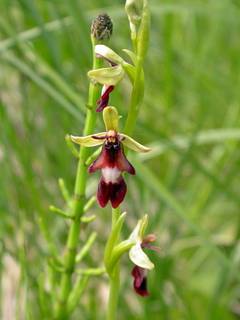
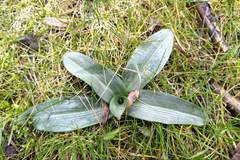
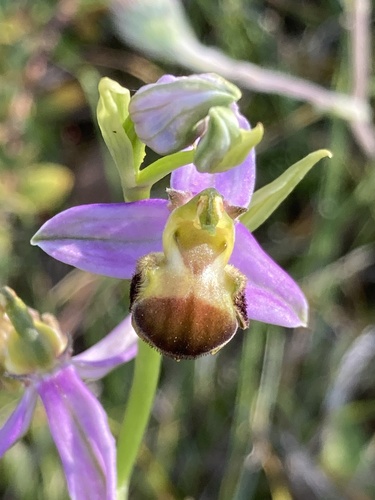
Ophrys apifera is a terrestrial perennial orchid 6-20 in (15-50 cm) tall, growing from a pair of underground tubers. A basal rosette of grey-green, lance-shaped leaves forms in autumn and overwinters, followed by an erect flower spike in late spring. Each spike carries two to ten flowers with three spreading pink to mauve sepals and a rounded, velvety lip about 0.4-0.6 in (1-1.5 cm) long that is maroon-brown with yellow markings, resembling the body of a female bee. The flower mimics a female bee to draw male bees in parts of its range, though across much of northern Europe it pollinates itself as the pollinia fall onto the stigma. After flowering the above-ground growth dies back and the plant persists as dormant tubers through summer and early autumn. It grows on calcareous grassland, dunes, road verges, and open scrub on lime-rich soils, and individual plants are often short-lived, appearing for a few seasons before disappearing. Colonies fluctuate widely from year to year depending on rainfall and grazing.
Native Range
Native to Europe, the Mediterranean Basin, North Africa, and the Middle East, where it grows on calcareous grasslands, dunes, and open scrub. It ranges north to Britain and Ireland and east to the Caucasus and Iran.Suggested Uses
Grown in calcareous wildflower meadows, naturalistic grassland, and conservation plantings on lime-rich soils. It is also kept in alpine and specialist collections, though it transplants poorly and is slow to establish.How to Identify
Appearance
Size & Dimensions
Height6" - 1'8"
Width/Spread4" - 8"
Bloom Information
Flowering occurs from late spring into midsummer, mainly May to July depending on latitude and altitude. Each spike opens its flowers from the bottom upward over two to three weeks. Mediterranean populations flower several weeks earlier than those in cooler northern regions.
Detailed Descriptions
Foliage Description
grey-greenGrowing Conditions
Sun Requirements
Requires 4-10 hours of direct sunlight daily
• Full Sun: 6+ hours of direct sunlight
• Partial Shade: 3-6 hours of direct sunlight
• Full Shade: Less than 3 hours of direct sunlight