Ophiopogon, Genus, japonicus, Species,
- Genus & species
mondo grass
East Asia (Japan, Korea, China, and the Philippines); forest understory, shaded slopes, and rocky ground.
Overview
Ophiopogon japonicus is a low-growing grass-like evergreen ground cover in the asparagus family (Asparagaceae) that grows 6-12 inches (15-30 cm) tall and spreads by stolons to form dense weed-suppressing mats. Despite the visual resemblance to a true grass, the plant is not a member of the grass family (Poaceae) but rather a monocot in the Asparagaceae family that includes asparagus, hosta, agave, yucca, lily-of-the-valley, and Solomon's seal — the resemblance to a grass is convergent rather than phylogenetic, with the narrow arching leaf form and the basal-crown habit having evolved separately in this lineage from the true grasses. Dark green narrow arching leaves 8-12 inches (20-30 cm) long create a narrow-grade textural appearance at ground level, with the leaf width and the leaf carriage giving the plant its mondo grass common name. Small pale lilac to white bell-shaped flowers appear on short spikes hidden within the foliage in July and August; the flowers are inconspicuous from a few feet away and are not the reason the species is grown in landscapes. Small dark-blue berry-like fruits 0.25 inch (6 mm) form in fall and persist through winter, visible at the leaf bases when the foliage is parted. The species is the standard shade and partial-shade ground cover in southeastern United States landscapes (USDA zones 7-10), where it fills the ecological role that lawn grass fills in sun. The stoloniferous spread (short underground runners, similar to those of strawberry but in a different family) gradually fills the gaps between planted clumps, producing a continuous carpet within 2-3 years at 6-8 inch (15-20 cm) initial spacing. Once established, mondo grass ranks among the more durable and low-input ground covers available, with strong tolerance of shade, heat, humidity, drought, clay soil, and root competition from established trees — the combination of tolerances that makes the species valuable for difficult shade-and-tree-root planting positions where most other ground covers fail. In USDA zone 6, the foliage may brown in severe winters but typically recovers from the roots in spring; in zones colder than 6, the plant is not reliably hardy. Deer avoid the tough fibrous foliage that the family produces from its dense lignified cell walls.
Native Range
Ophiopogon japonicus is native to East Asia, with a range across Japan, Korea, China, and the Philippines. The species occurs in forest understory, shaded slopes, and rocky ground at elevations from sea level to mid-mountain in the temperate East Asian range. The shade-tolerant evergreen ground-cover habit reflects the species' forest-floor evolution, where the dense canopy of broadleaf and coniferous trees creates the deep-shade conditions that the species is adapted to.Suggested Uses
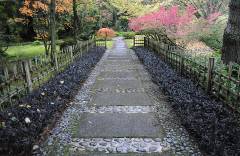
Used as a shade ground cover, between stepping stones along garden paths, along path edges, under established trees where turf grass will not grow because of the dense root competition and shade, and in containers of 1 gallon (3.8 liters) or larger as a textural foliage element. The species is the standard lawn alternative for shaded southeastern United States landscapes, where it fills the ground-cover role that turf grass fills in sun-exposed positions. The dense stoloniferous mat works well on slopes for erosion control because the runners hold the soil while the foliage canopy reduces raindrop impact on the bare ground. The plant is a recurring component of Japanese-style and Asian-themed garden designs because of the species' East Asian native range and the historical use of the genus in Japanese garden traditions.How to Identify
Appearance
Size & Dimensions
Height6" - 1'
Width/Spread1' - 1'6"
Colors
Bloom Information
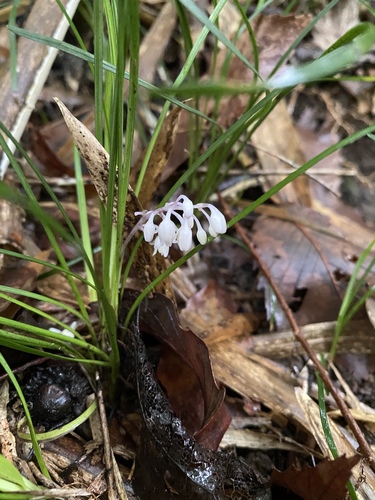
Small pale lilac to white bell-shaped flowers open on short spikes hidden within the foliage in July and August across a 3-week active flowering window. The flowers are not ornamentally significant — they are partly visible only when the foliage is parted by hand, and at typical viewing distance the plant appears to be in foliage-only mode through the summer. Small dark-blue berry-like fruits develop after pollination and persist through fall and winter at the leaf bases, providing a small but real textural feature for close-range observation.
Detailed Descriptions
Flower Description
Small pale lilac to white bell-shaped flowers carried on short spikes hidden within the foliage in mid-summer; the flowers are inconspicuous from a few feet away and are not the reason the species is grownFoliage Description
Dark green; narrow arching grass-like leaves 8-12 inches (20-30 cm) long emerging from a basal crown, with the visual resemblance to a true grass being superficial — the plant belongs to the Asparagaceae family (along with asparagus, hosta, agave, yucca, lily-of-the-valley, and Solomon's seal) rather than to the true grass family PoaceaeGrowing Conditions
Sun Requirements
Requires 2-8 hours of direct sunlight daily
• Full Sun: 6+ hours of direct sunlight
• Partial Shade: 3-6 hours of direct sunlight
• Full Shade: Less than 3 hours of direct sunlight
Care & Maintenance
Care Guide
Plant in partial shade to full shade with 2-8 hours of dappled or filtered light; in cooler climates, full sun positions work if soil moisture is adequate. Average well-drained soil at pH 5.5-7.0 supports the species across loam, clay, and sandy substrates; the species' broad soil tolerance is one of the reasons it works as a low-input ground cover in difficult positions. Spacing of 6-8 inches (15-20 cm) between planted clumps allows the stoloniferous spread to fill the gaps within 2-3 years for a continuous mat. Mowing or trimming the foliage in late February or March before new growth emerges handles winter-tattered leaves; the mower is set to its highest cutting height (3-4 inches / 8-10 cm) to avoid cutting into the basal crown, and new growth replaces the trimmed foliage within 4-6 weeks of growing-season conditions. Fertilization is omitted because the species is adapted to lean forest-floor soils and does not benefit from added nutrients. The species is one of the lower-input ground covers available for shade in zones 7-10.Pruning
Mowing or trimming the foliage in late February through March handles winter-tattered leaves. The mower is set to its highest cutting height (3-4 inches / 8-10 cm) to avoid cutting into the basal crown, and new growth replaces the trimmed foliage within 4-6 weeks of growing-season conditions. No other seasonal pruning is needed.Pruning Schedule
Prune: March
early spring
Container Growing
Suitable for container growing
Minimum container size: 1 gallons