Overview
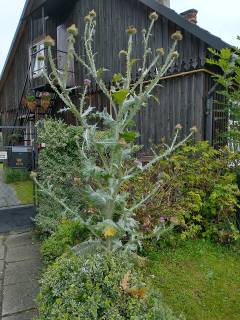
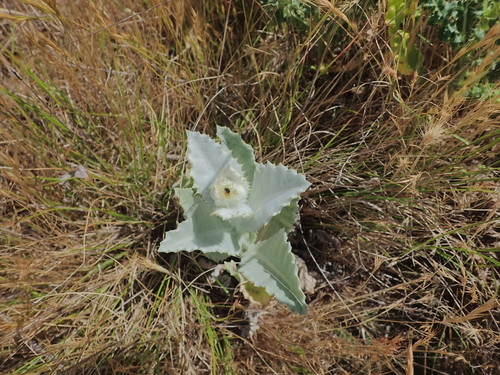
Onopordum acanthium is a massive spiny biennial in the family Asteraceae reaching 3-8 feet (0.9-2.4 m) tall and 3-6 feet (0.9-1.8 m) wide, ranking with the largest thistles of North America by height and rosette diameter. The entire plant is covered densely in white to gray woolly tomentum, giving a silver-gray appearance visible from a distance. First-year plants form a basal rosette up to 3 feet (0.9 m) across, carrying deeply lobed spine-tipped leaves 6-18 inches (15-45 cm) long. Second-year stems are erect, stout, up to 2 inches (5 cm) in diameter at the base, with spiny wings running the full length of the stem; the wings are 0.3-0.8 inch (8-20 mm) wide, continuous, and armed with stout spines up to 0.4 inch (10 mm) long. Flower heads are solitary or in small clusters, 1.5-2.5 inches (4-6 cm) in diameter, globe-shaped, with purple to pink disc florets and no ray florets. Phyllaries (involucral bracts) are spine-tipped. A single plant produces 8,000-40,000 seeds, with wind dispersal by the pappus. Seeds remain viable in soil for 10 years or more. The species is listed as a Class B noxious weed in Washington State and forms dense impenetrable stands on rangeland, roadsides, and waste ground.
Native Range
Onopordum acanthium is native to Europe and western Asia, in roadsides, waste ground, pastures, and disturbed sites from sea level to approximately 6,000 feet (1,800 m). Introduced to North America as an ornamental and escaped cultivation. Widely naturalized in the western United States, particularly in semi-arid rangeland of the intermountain West and eastern Washington and Oregon.Suggested Uses
Used in noxious-weed identification training for rangeland managers. The spiny-winged stem morphology is the primary diagnostic teaching feature separating Onopordum from Cirsium and Carduus. Studied in rangeland weed ecology and in impenetrable-thicket formation by large thistles. The dense woolly tomentum carries the species into leaf-surface-adaptation curricula for drought tolerance.How to Identify
Appearance
Size & Dimensions
Height3' - 8'
Width/Spread3' - 6'
Bloom Information
Globe-shaped flower heads 1.5-2.5 inches (4-6 cm) in diameter with purple to pink disc florets and no ray florets, borne June through August in the second year over 3-4 weeks. Bees, butterflies, and other insects pollinate the flowers. Seeds mature 3-4 weeks after flowering and disperse by wind via the pappus. In the Pacific Northwest peak bloom falls in July. Plants die after seed set (monocarpic biennial).
Detailed Descriptions
Flower Description
Purple to pink; globe-shaped flower heads 1.5-2.5 inches (4-6 cm) with no ray florets; June-August (second year)Foliage Description
Gray-green to silver-white from dense woolly tomentum on both surfaces; deeply lobed with spine-tipped margins; deciduousGrowing Conditions
Sun Requirements
Requires 6-12 hours of direct sunlight daily
• Full Sun: 6+ hours of direct sunlight
• Partial Shade: 3-6 hours of direct sunlight
• Full Shade: Less than 3 hours of direct sunlight