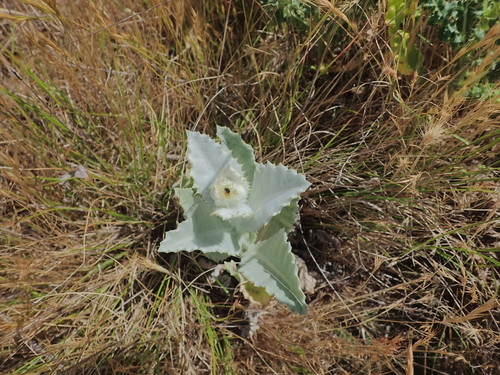
Onopordum, Genus, spp., Multiple species,
- Genus
- Multiple species
cotton thistles
Europe, North Africa, and western and central Asia
Overview
Onopordum is a genus of about 40 large biennial and short-lived perennial thistles in the family Asteraceae, native to Europe, North Africa, and western and central Asia. In the first year plants form a broad rosette of spiny, grey-green leaves coated in dense white woolly hairs; in the second year they send up branched, spiny-winged stems 3-10 feet (0.9-3 m) tall and 2-4 feet (0.6-1.2 m) wide. The leaves are deeply lobed with stout marginal spines, and the felted hairs give the foliage a silvery cast that suits the common name cotton thistle. Globular flower heads 1-2 inches (2.5-5 cm) across open from midsummer in purple, reddish-purple, or occasionally white, surrounded by spine-tipped bracts. Each head produces many wind-dispersed seeds, and a single plant of O. acanthium can set thousands. The genus grows on disturbed ground, roadsides, pastures, and dry slopes, tolerating poor, dry, alkaline soils. O. acanthium is listed as a noxious weed in several western and central United States and across parts of Australia, where it forms dense, impenetrable stands. After flowering and setting seed, the plant dies.
Native Range
Native to Europe, North Africa, and western and central Asia, in dry grassland, disturbed ground, and stony slopes. O. acanthium has naturalized widely in North America, South America, and Australia.Suggested Uses
Grown as a bold architectural accent in gravel gardens, dry borders, and wild plantings for its height and silver foliage. The dried seed heads are used in arrangements. Because several species spread aggressively from seed, planting is restricted in regions where they are listed as noxious weeds.How to Identify
Appearance
Size & Dimensions
Height3' - 10'
Width/Spread2' - 4'
Bloom Information
Flowers from July to September in the second year. Individual plants bloom for about 6 weeks as the branched stems open heads in succession. Bees and butterflies visit the flowers, and goldfinches feed on the ripening seed.
Detailed Descriptions
Flower Description
purple to reddish-purple, sometimes whiteFoliage Description
grey-green, woolly whiteGrowing Conditions
Sun Requirements
Requires 6-12 hours of direct sunlight daily
• Full Sun: 6+ hours of direct sunlight
• Partial Shade: 3-6 hours of direct sunlight
• Full Shade: Less than 3 hours of direct sunlight
Care & Maintenance
Care Guide
Grows in full sun on dry, well-drained soil across a pH range of about 6.0-8.0, including poor, stony, and alkaline ground. Established plants are drought tolerant and need no supplemental water in most climates. Rich or moist soil produces lush growth that can flop and self-sow heavily. Removing seed heads before they ripen limits the spread that has made some species invasive. Plants are easily pulled or cut at the root crown while young. No feeding is required.Pruning
Spent flower heads are removed before seed sets to prevent prolific self-sowing. The dead stems are cut to the ground after the plant completes flowering in its second year. Stems and leaves carry sharp spines along their length.Pruning Schedule
Prune: August–September
summerfall
