Myrsine, Genus, spp., Multiple species,
- Genus
- Multiple species
colicwood
Africa, Asia, the Pacific, the Americas, and New Zealand
Overview
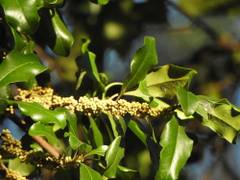
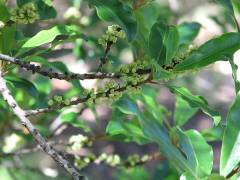
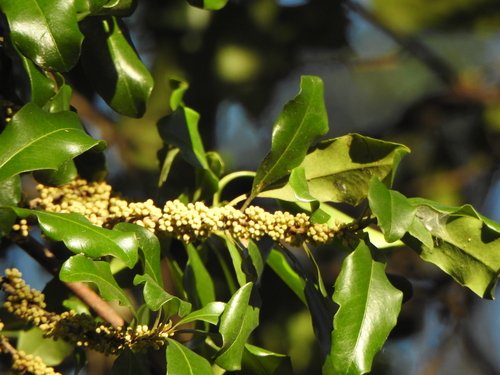
Myrsine is a large genus of about 200-300 species of evergreen shrubs and small trees in the Primulaceae (formerly Myrsinaceae), distributed through tropical and warm-temperate regions of Africa, Asia, the Pacific, the Americas, and New Zealand. Plants range from low shrubs to trees 50 feet (15 m) tall, with alternate, leathery leaves that are often gland-dotted and crowded toward the branch tips. Most species are dioecious, carrying separate male and female plants. The flowers are small, 0.1-0.2 inch (3-5 mm) across, greenish, white, or pink-tinged, and packed in tight clusters set directly along the older stems rather than at the shoot tips. Female plants follow with small rounded berries 0.2-0.3 inch (4-8 mm) across that ripen blue, purple, red, or black and are eaten by birds. The genus includes M. africana, grown widely as a clipped hedge, and M. australis, the New Zealand mapou. Plants are slow-growing and frost-tender to half-hardy depending on origin, and the small, stem-borne flowers are easy to miss.
Native Range
Native across tropical and warm-temperate Africa, southern and eastern Asia, the Pacific Islands, New Zealand, and the warmer parts of the Americas, including Florida. Species grow in forest, forest margins, scrub, and rocky slopes, from coastal lowlands to montane elevations.Suggested Uses
Used as evergreen hedging, screening, foundation shrubs, and clipped topiary in mild climates, with M. africana spaced 12-18 inches (30-45 cm) apart for a dense hedge. Larger species serve as small specimen trees, and berrying female plants draw fruit-eating birds. Compact forms are grown in containers in cool regions.How to Identify
Appearance
Size & Dimensions
Height2' - 50'
Width/Spread2' - 15'
Bloom Information
Flowering is inconspicuous and occurs mainly in spring, though warm-climate species may flower over a longer period. Because plants are usually dioecious, only female plants set the rounded berries, and only when a male plant grows nearby. Fruit ripens over the following months and can persist into winter.
Detailed Descriptions
Flower Description
greenish, white, or pink-tingedFoliage Description
glossy dark greenGrowing Conditions
Sun Requirements
Requires 4-10 hours of direct sunlight daily
• Full Sun: 6+ hours of direct sunlight
• Partial Shade: 3-6 hours of direct sunlight
• Full Shade: Less than 3 hours of direct sunlight
Care & Maintenance
Care Guide
Myrsine are grown in full sun to part shade in moist, well-drained soils with a pH from about 5.5 to 7.0. Most tolerate a range of soils, including poor and rocky ground, once established, and several are wind- and coast-tolerant. Hardiness varies with species: M. africana withstands light frost in roughly USDA zones 8-10, while tropical species need frost-free conditions. Watering is regular during establishment, then moderate, since plants tolerate neither prolonged drought nor waterlogging. Growth is slow, so hedges and screens take several years to fill in. Propagation is from seed or semi-ripe cuttings.Pruning
The genus tolerates regular clipping, and M. africana is sheared as a formal hedge or topiary in late spring and summer. Other species need only the removal of dead or wayward growth. Hard renovation pruning is done in spring, after which slow regrowth follows.Container Growing
Suitable for container growing