Mitella, Genus, ovalis, Species,
- Genus & species
coastal miterwort
Overview
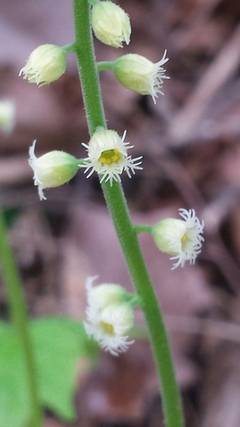
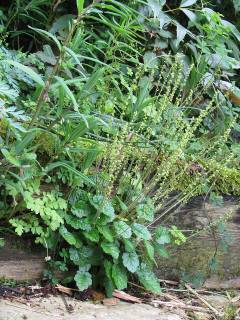
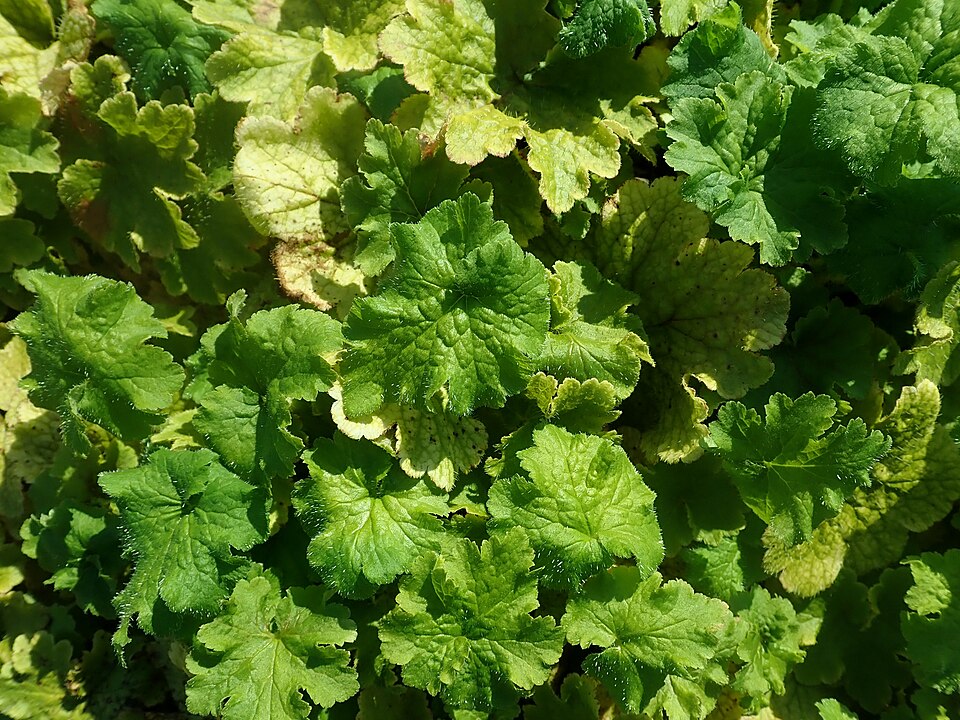
A small herbaceous semi-evergreen perennial reaching 4-12 inches (10-30 cm) tall when in flower from a short, stout rhizome. Basal leaves oval to broadly oblong, 0.5-2 inches (1.5-5 cm) wide, with shallow rounded teeth, dark green and slightly hairy, held on petioles 1-3 inches (2.5-7.5 cm) long. Flowering scape leafless and slender, rising from the basal rosette and bearing a one-sided raceme of 5-15 small greenish-white flowers. Each flower 0.2-0.25 inch (5-6 mm) wide, with 5 deeply pinnately divided petals creating a snowflake-like outline. Capsules small, splitting into a cup-shaped fruit 0.1 inch (2.5 mm) wide, ripening in summer. Plants spread slowly by short stoloniferous rhizomes, forming loose mats 6-10 inches (15-25 cm) wide after 4-6 years. Foliage persists through winter in coastal zones 7-9 with bronze-purple winter coloration; older leaves are gradually replaced as new spring foliage emerges.
Native Range
Native to moist coniferous and mixed forests of western North America from southern Alaska south through coastal British Columbia, Washington, Oregon, and into northwestern California. Found in shaded streambanks, mossy rock outcrops, and coastal forest understory at sea level to 3,000 feet (900 m) elevation.Suggested Uses
Commonly planted in shaded woodland gardens, native plant restoration projects, and coastal rain gardens at 6-10 inch (15-25 cm) spacing. Suitable for shaded containers of at least 1 gallon (3.8 L) with consistent moisture and high organic matter content. Pairs in cultivation with other moist-shade natives such as Tiarella trifoliata, Asarum caudatum, and ferns.How to Identify
Appearance
Size & Dimensions
Height4" - 1'
Width/Spread6" - 10"
Bloom Information
April through June depending on elevation and latitude; coastal lowland populations bloom in April-May, montane and northern populations into June. Individual flowers last 5-7 days; the full bloom period in a stand extends 3-5 weeks.
Detailed Descriptions
Foliage Description
dark greenGrowing Conditions
Sun Requirements
Tolerates up to 4 hours of direct sunlight daily
• Full Sun: 6+ hours of direct sunlight
• Partial Shade: 3-6 hours of direct sunlight
• Full Shade: Less than 3 hours of direct sunlight
Care & Maintenance
Care Guide
Plant container-grown specimens in autumn or early spring into shaded soil with high organic matter. Maintain even soil moisture during the growing season; the species shows leaf scorch within 1-2 weeks of drought. Mulch with 1-2 inches (2.5-5 cm) of leaf mold annually to maintain soil moisture. Slugs feed on young foliage in mild wet springs and may damage emerging flower scapes. Plants establish over 2-3 years and persist 10 or more years in stable coastal woodland sites.Pruning
No active pruning is needed. Spent flower scapes can be removed after seed has dispersed in summer. Winter-bronzed leaves can be left in place; new foliage replaces them gradually as spring growth emerges.Container Growing
Suitable for container growing
Minimum container size: 1 gallons