Mirbelia, Genus, rubiifolia, Species,
- Genus & species
heathy mirbelia
Overview
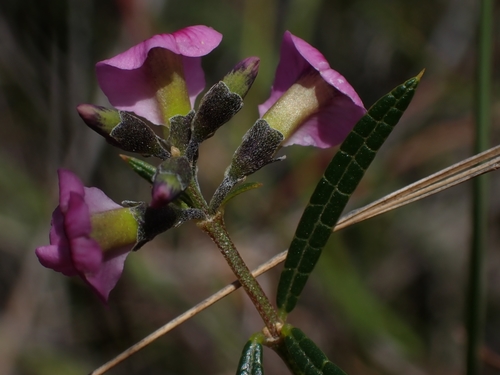
Mirbelia rubiifolia is a low evergreen shrub reaching 6-20 inches (15-50 cm) tall and spreading 12-32 inches (30-80 cm) wide, with a low, sprawling habit and wiry stems. Leaves are arranged in whorls of three, ovate to heart-shaped, 0.3-1 inch (8-25 mm) long, with a net of raised veins and a small point at the tip. Pea-shaped flowers 0.4-0.6 inch (1-1.5 cm) across open in the upper leaf axils, with pink to mauve-purple petals and a darker centre, mainly in spring and early summer. The flowers are followed by small inflated pods. As a legume it fixes atmospheric nitrogen through root nodules. Growth is slow to moderate, and plants are short-lived, often persisting 4-8 years. It grows in sandy, well-drained heath soils and regenerates from seed after fire. It declines in heavy clay and waterlogged ground.
Native Range
Native to eastern Australia, in Queensland and New South Wales. Grows in heath and dry sclerophyll woodland on sandstone-derived sandy soils, mainly in coastal and near-coastal districts below about 2,300 feet (700 m).Suggested Uses
Used as a low groundcover or front-of-border plant in native and rockery gardens, spaced 16-24 inches (40-60 cm) apart. Suited to sandy banks and informal native plantings where a low, spreading shrub is wanted. Grows in containers of at least 2 gallons (8 L) with free-draining mix.How to Identify
Appearance
Size & Dimensions
Height6" - 1'8"
Width/Spread1' - 2'8"
Bloom Information
Flowers in spring and early summer, mainly September to December in its native range. Individual flowers last about a week, and the plant carries scattered bloom over 6-10 weeks. Flowering is heaviest in open, sunny positions following good rain.
Detailed Descriptions
Flower Description
pink to mauve-purpleFoliage Description
greenGrowing Conditions
Sun Requirements
Requires 4-9 hours of direct sunlight daily
• Full Sun: 6+ hours of direct sunlight
• Partial Shade: 3-6 hours of direct sunlight
• Full Shade: Less than 3 hours of direct sunlight
Care & Maintenance
Care Guide
Grows in full sun to light shade in sandy, sharply drained soil. Water moderately during establishment; established plants tolerate dry periods but decline in wet, heavy ground. As a nitrogen-fixing legume it grows on low-fertility soils without added fertilizer. It can be propagated from scarified seed or cuttings. Plants are short-lived, often replaced after 4-8 years. Root rots develop in poorly drained or summer-humid sites.Pruning
Trim lightly after flowering to keep a compact, spreading shape; the wiry stems tolerate removal of up to one-third of the season growth. Bare old wood reshoots poorly, so trimming is kept to leafy stems. Remove dead stems as they appear.Pruning Schedule
Prune: December–January
summer
Container Growing
Suitable for container growing
Minimum container size: 2 gallons