Microseris, Genus, walteri, Species,
- Genus & species
Murnong
Overview
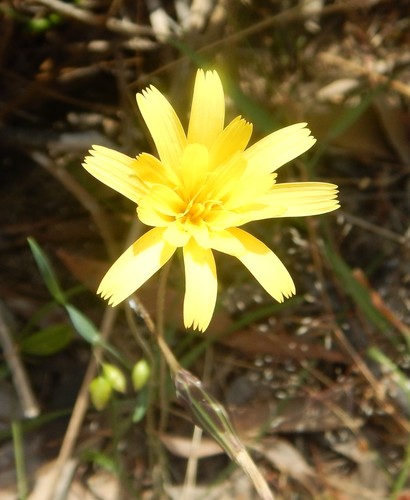
Microseris walteri is a tuberous perennial herb forming a basal rosette of narrow leaves 2-12 inches (5-30 cm) long, which are linear to lance-shaped and often lobed or toothed. From the rosette a single leafless stem 4-20 inches (10-50 cm) tall carries one yellow flower head 0.8-1.6 inches (2-4 cm) across, made up entirely of ray florets, resembling a dandelion. The buds and developing seed heads nod or droop before opening and after flowering. Below ground the plant produces one or more fleshy, tuberous roots 0.4-2.4 inches (1-6 cm) long, which were a staple food of Aboriginal peoples in southeastern Australia. Flowering occurs in spring. The above-ground parts die back to the tubers in summer dormancy, and the plant resprouts after autumn and winter rains. It grows in grassland and open woodland and is sensitive to heavy grazing and soil disturbance.
Native Range
Native to southeastern Australia, across Victoria, Tasmania, New South Wales, South Australia, and Western Australia. Grows in native grasslands, grassy woodlands, and open forest on a range of soils, from the lowlands to subalpine areas.Suggested Uses
Used in native grassland restoration, meadow gardens, and bush-food plantings, spaced 6-12 inches (15-30 cm) apart. The edible tubers are grown as a traditional food crop. It suits open, sunny sites with low competition from vigorous grasses.How to Identify
Appearance
Size & Dimensions
Height4" - 1'8"
Width/Spread4" - 1'
Bloom Information
Flowers in spring, mainly September to November. Each flower head opens in the morning and closes by afternoon, lasting a few days. The plant then sets seed and dies back to its tubers over summer.
Detailed Descriptions
Foliage Description
greenGrowing Conditions
Sun Requirements
Requires 6-10 hours of direct sunlight daily
• Full Sun: 6+ hours of direct sunlight
• Partial Shade: 3-6 hours of direct sunlight
• Full Shade: Less than 3 hours of direct sunlight
Care & Maintenance
Care Guide
Grows in full sun to light shade in well-drained loamy or sandy soils. Water during the autumn-to-spring growing season; the plant is dormant and needs no water over summer. Growth resumes from the tubers after autumn rains. It is sensitive to heavy grazing, competition from introduced grasses, and frequent soil cultivation. Few pests affect it. Tubers can be divided when the plant is dormant.Pruning
No pruning is required. Spent flower stems can be removed after seed set, or left to allow self-seeding. Dead foliage dies back naturally as the plant enters summer dormancy.Container Growing
Suitable for container growing
Minimum container size: 2 gallons