© Solipsist~commonswiki, some rights reserved (CC-BY-SA) · Wikimedia Commons
Mespilus germanica
medlar
Southeastern Europe (Turkey, the Balkans, Greece) and southwestern Asia (Iran, Caucasus); forest margins and open woodlands; widely naturalized across western and central Europe through centuries of cultivation
Overview
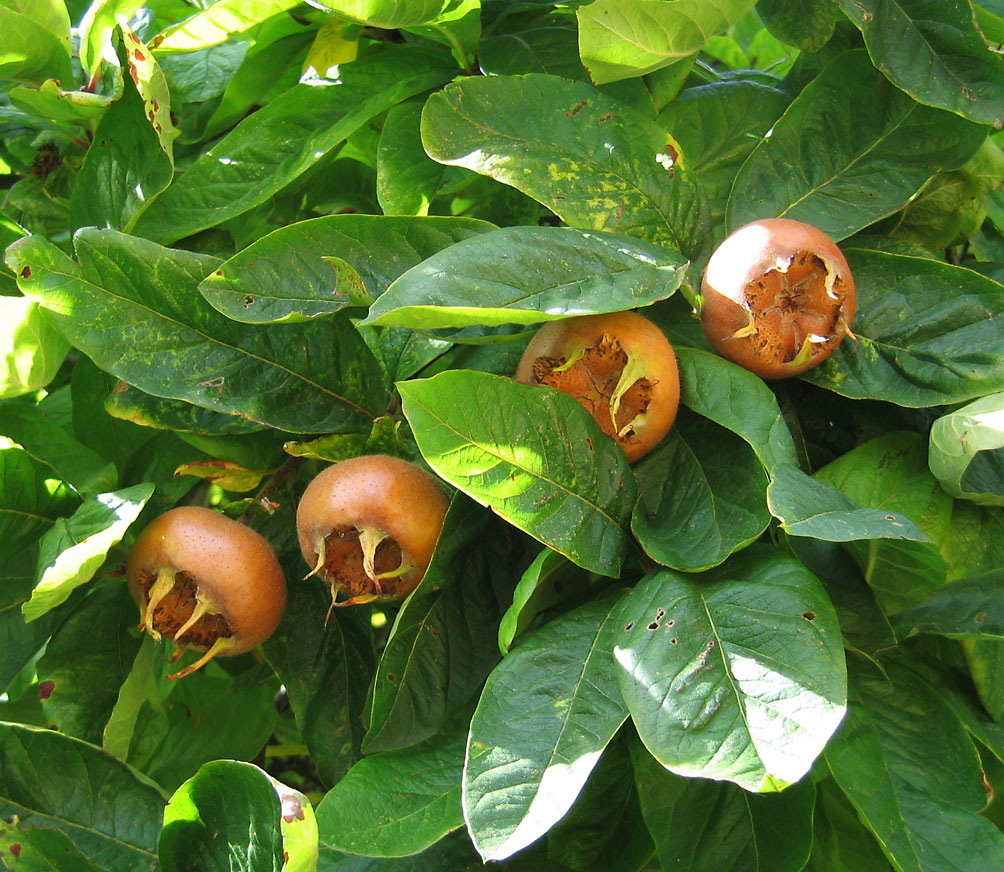
Mespilus germanica is a small deciduous tree or large shrub reaching 12-20 feet (3.6-6 m) tall with a spread of 12-20 feet (3.6-6 m) and a broadly spreading, often irregular crown with somewhat contorted branches. The species is among the oldest cultivated fruit trees in Europe, grown at least since Roman times and widely naturalized through centuries of garden use. Alternate oblong to lanceolate leaves 3-5 inches (8-13 cm) long are dark green above with dense soft pubescence beneath, turning bronze-yellow to russet-brown in autumn. Solitary 5-petaled white to pale pink flowers 1-1.5 inches (2.5-4 cm) across open terminally on short shoots in May-June; bloom duration is 2-3 weeks. The pome fruit is brown, apple-like in outline, 1-2 inches (2.5-5 cm) across, and carries a wide-open calyx end that exposes the seeds. Fruit ripens in late October-November and requires bletting — controlled softening after frost — before the flesh becomes palatable. Growth rate is slow to moderate. Hardy to USDA zone 4. Self-fertile; a single tree sets fruit without a pollinator partner. Non-toxic. The irregular crown and contorted branching produce a naturalistic silhouette rather than a tidy outline.
Native Range
Mespilus germanica is native to southeastern Europe (Turkey, the Balkans, Greece) and southwestern Asia (Iran, Caucasus), in forest margins and open woodlands. The species has been widely naturalized across western and central Europe through centuries of cultivation.Suggested Uses
Used as an orchard or specimen tree in residential gardens and edible landscapes in zones 4-8 at 12-15 foot (3.6-4.5 m) spacing. Principal features are the contorted branch structure, autumn leaf color, and the historical interest of an ancient cultivated fruit tree. Fruit requires bletting and is culinarily unfamiliar to most contemporary gardeners; the crop is a niche product rather than a mainstream fruit. The irregular spreading crown gives a naturalistic appearance. Self-fertile, so a single tree produces fruit. Not suited to formal landscapes or positions where a tidy, symmetrical habit is required.How to Identify
Appearance
Size & Dimensions
Height12' - 20'
Width/Spread12' - 20'
Reaches mature size in approximately 10 years
Bloom Information
Solitary 5-petaled white to pale pink flowers 1-1.5 inches (2.5-4 cm) across, borne terminally on short shoots in May-June. Bloom duration is 2-3 weeks. Fruit is brown, apple-like, 1-2 inches (2.5-5 cm) across, with a characteristic wide-open calyx end exposing the seeds. Fruit ripens in late October-November and requires bletting — controlled softening after frost — before it becomes palatable.
Detailed Descriptions
Flower Description
White to pale pink solitary flowers 1-1.5 inches (2.5-4 cm) across with 5 petals; borne terminally on short shoots in May-JuneFoliage Description
Dark green above with dense soft pubescence beneath; alternate oblong to lanceolate 3-5 inches (8-13 cm) long; bronze-yellow to russet-brown in autumnGrowing Conditions
Sun Requirements
Requires 4-10 hours of direct sunlight daily
• Full Sun: 6+ hours of direct sunlight
• Partial Shade: 3-6 hours of direct sunlight
• Full Shade: Less than 3 hours of direct sunlight
Care & Maintenance
Care Guide
Grows in full sun to partial shade in well-drained, acidic to neutral soil at pH 5.5-7.0. Hardy to USDA zone 4. Tolerates a range of soils including clay, silt, and loam. Drought tolerant once established. Self-fertile; no pollinator partner required. Growth rate is slow to moderate. No significant pest or disease problems. Fruit must be bletted (held until soft after frost) before it is palatable, and unbletted fruit has an astringent texture that most tasters reject.Pruning
Minimal pruning required. Remove dead, crossing, or damaged branches in late winter. The naturally irregular, spreading form with somewhat contorted branches is characteristic of the species and reads as deliberate rather than neglected. The tree can be trained as a single-trunk standard or allowed to develop as a multi-stemmed large shrub depending on early training.Pruning Schedule
J
F
M
A
M
J
J
A
S
O
N
D
late winter