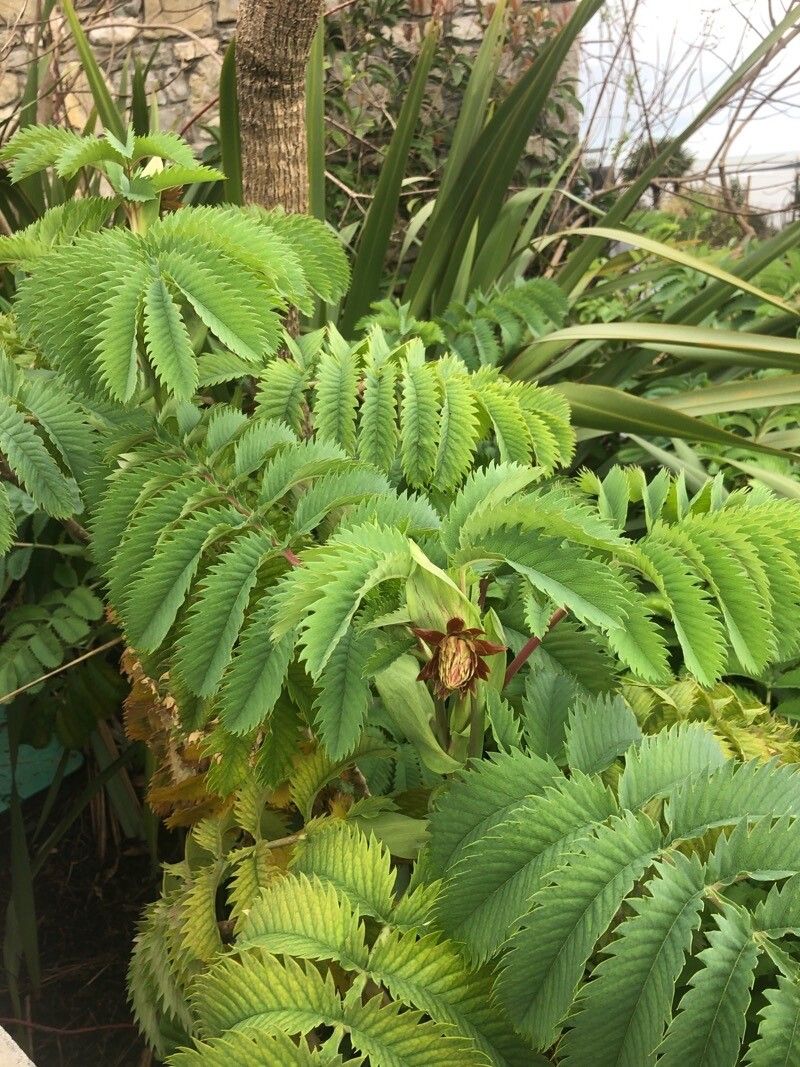
Melianthus, Genus, spp., Multiple species,
- Genus
- Multiple species
honey bush
Overview
Melianthus is a genus of about six evergreen shrubs in the family Francoaceae, native to southern Africa and known as honey bush. The species most often grown, M. major, forms a sprawling, suckering shrub 6-10 ft (1.8-3 m) tall and as wide, though it is often cut back yearly and kept to 3-5 ft (0.9-1.5 m) as a foliage plant. The large pinnate leaves, 12-18 in (30-45 cm) long, are blue-gray to gray-green with deeply and sharply toothed leaflets, and give off a strong scent, often likened to peanut butter, when bruised. Erect spikes 12-32 in (30-80 cm) tall carry tubular brick-red to maroon flowers in spring, each holding copious blackish nectar that draws sunbirds in the wild and bees in cultivation. Slightly inflated papery seed capsules follow. All parts are toxic if eaten. Plants are frost-tender, with top growth cut down by hard frost, though established roots resprout in mild climates.
Native Range
Melianthus is native to southern Africa, chiefly South Africa, where species grow on disturbed ground, streambanks, rocky slopes, and forest margins from the coast into the mountains. M. major has naturalized in parts of Australia, New Zealand, California, and the Mediterranean.Suggested Uses
Melianthus is grown for its blue-gray foliage in subtropical borders, gravel and coastal gardens, and large containers, and as a cut-back foliage accent in cold-winter regions. Plants are spaced 4-6 ft (1.2-1.8 m) apart where allowed to reach full size. The bold leaves contrast with narrow-leaved grasses and perennials.How to Identify
Appearance
Size & Dimensions
Height6' - 10'
Width/Spread6' - 10'
Bloom Information
Flowering occurs mainly in spring, from late winter into early summer depending on climate, on stout erect spikes. The tubular dark-red flowers produce abundant nearly black nectar and are bird-pollinated in their native range. Papery, bladder-like seed capsules form through summer.
Detailed Descriptions
Flower Description
Brick-red to maroonFoliage Description
Blue-gray to gray-greenGrowing Conditions
Sun Requirements
Requires 6-10 hours of direct sunlight daily
• Full Sun: 6+ hours of direct sunlight
• Partial Shade: 3-6 hours of direct sunlight
• Full Shade: Less than 3 hours of direct sunlight
Care & Maintenance
Care Guide
Melianthus grows in full sun to light shade in fertile, well-drained soil with a pH of 6.0-7.5 and moderate moisture. The genus is frost-tender, hardy in USDA zones 8-11, with top growth killed near 20 F (-7 C) but roots often resprouting in zones 8-9. In cold areas it is treated as a cut-back foliage shrub or container plant overwintered under cover. Plants spread by suckers and can colonize, so root spread is checked where space is limited. Wind shreds the large leaves, so a sheltered position keeps foliage intact. Dry summer soil causes wilting and leaf scorch.Pruning
Melianthus is cut back hard in early spring, with old stems reduced to 6-12 in (15-30 cm) above ground to spur fresh, well-colored foliage. Where grown for flowers, only frost-damaged and spent flowering stems are removed instead. Suckers are dug out to control spread.Container Growing
Suitable for container growing
Minimum container size: 7 gallons
Toxicity Warning
Toxic to pets and humansMore plants in the Shrub category
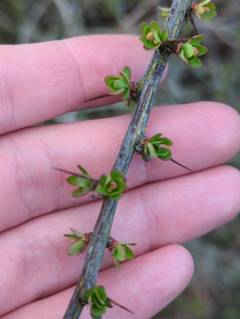 Japanese barberryBerberis thunbergii
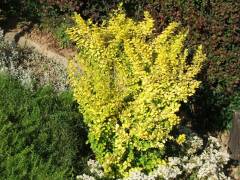 Golden Japanese barberryBerberis thunbergii 'Aurea'
- Purpleleaf or redleaf Japanese barberryBerberis thunbergii f. atropurpurea
- Helmond Pillar Japanese barberryBerberis thunbergii f. atropurpurea 'Helmond Pillar'
- Crimson pygmy barberryBerberis thunbergii f. atropurpurea 'Atropurpurea Nana'
- Rose glow Japanese barberryBerberis thunbergii f. atropurpurea 'Rose Glow'