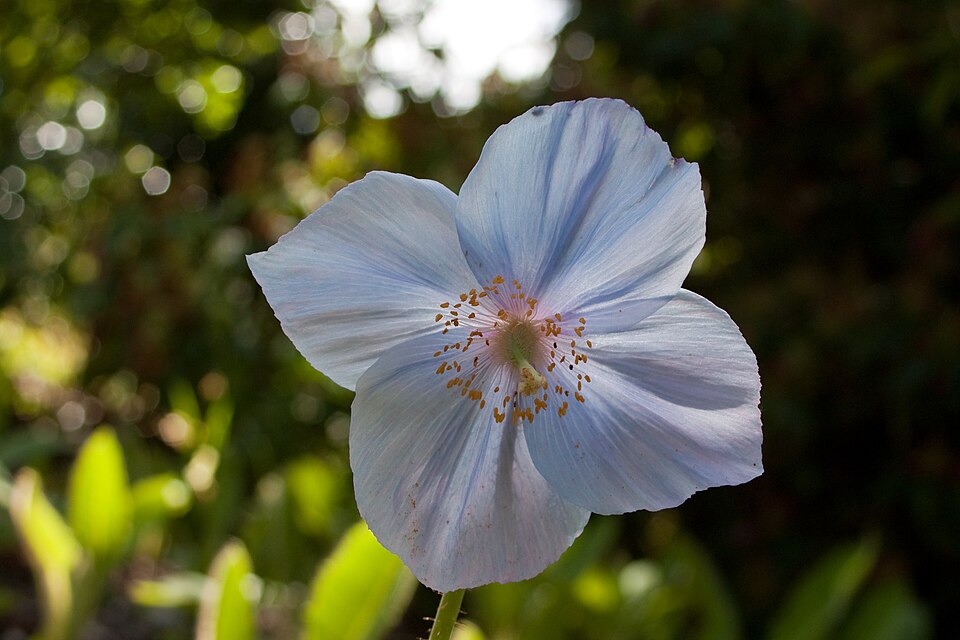
Meconopsis, Genus, 'Lingholm', Cultivar,
- Genus
- Cultivar
blue poppy
Hybrid of garden origin — parent species {M. grandis} and {M. betonicifolia} from the eastern Himalayas (Nepal, Bhutan, Tibet, Yunnan) at 10,000-15,000 feet (3,000-4,600 m) elevation
Overview
Meconopsis 'Lingholm' is blue poppy (Himalayan blue poppy), a clumping deciduous perennial growing 3-4 feet (0.9-1.2 m) tall and 18-24 inches (45-60 cm) wide. Sky-blue to cobalt-blue saucer-shaped flowers 3-4 inches (7-10 cm) with 4-6 silky petals and golden stamens in May-June (5 weeks). Oblong mid-green leaves densely covered in tawny-golden bristly hairs in a basal rosette. In Papaveraceae. A fertile perennial hybrid (M. grandis × M. betonicifolia). Parent species from the eastern Himalayas at 10,000-15,000 feet (3,000-4,600 m). Requires cool moist maritime climates — daytime temperatures above 75°F (24°C) cause rapid decline and death. This intolerance of summer heat is the primary limitation — successful cultivation is restricted to the Pacific Northwest, UK, and similar cool humid regions. Acidic soil (pH 5.5-6.5) required — alkaline conditions produce purple or mauve flowers instead of blue. Remove first-year flower buds to build crown strength. Not drought-tolerant. Deer-resistant. Non-toxic. Zones 5-8. Part shade to full shade. Growth rate is moderate.
Native Range
Hybrid of garden origin — parent species M. grandis and M. betonicifolia from the eastern Himalayas (Nepal, Bhutan, Tibet, Yunnan) at 10,000-15,000 feet (3,000-4,600 m) elevation.Suggested Uses
Grown in cool moist shade borders, woodland gardens, and bog-edge plantings in maritime climates, spaced 18-24 inches (45-60 cm). Requires cool summers and acidic soil. Not for hot-summer regions. Non-toxic. Zones 5-8.How to Identify
Appearance
Size & Dimensions
Height3' - 4'
Width/Spread1'6" - 2'
Bloom Information
Detailed Descriptions
Flower Description
Sky-blue to luminous cobalt-blue, saucer-shaped, 3-4 inches (7-10 cm), with 4-6 silky petals and a central boss of golden stamens; the blue color is pH- and temperature-dependent — alkaline soil and hot conditions produce purple or mauve flowers instead of blueFoliage Description
Oblong to lance-shaped, mid-green, 4-8 inches (10-20 cm), densely covered in tawny-golden bristly hairs; forms a basal rosette in the first yearGrowing Conditions
Sun Requirements
Requires 1-4 hours of direct sunlight daily
• Full Sun: 6+ hours of direct sunlight
• Partial Shade: 3-6 hours of direct sunlight
• Full Shade: Less than 3 hours of direct sunlight
Care & Maintenance
Care Guide
Part shade to full shade (1-4 hours). Moist well-drained acidic soil pH 5.5-6.5. High moisture required — not drought-tolerant. Cool moist maritime climate required (daytime below 75°F / 24°C). Remove first-year flower buds. Deadhead to prevent monocarpic death. Cut dead foliage in fall. Non-toxic. Deer-resistant. Zones 5-8.Pruning
Remove spent flowers promptly. Remove first-year flower buds to build crown. Cut all dead foliage to the ground in fall (October).Pruning Schedule
Prune: June & October
summerfall