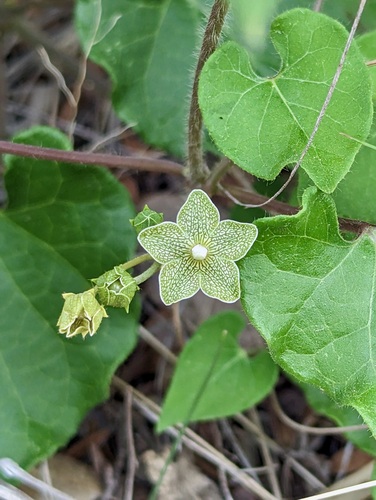
Matelea, Genus, reticulata, Species,
- Genus & species
pearl milkweed
Central and southern Texas, northeastern Mexico
Overview
Matelea reticulata is a slender, twining herbaceous perennial vine in the milkweed family, climbing 3-7 ft (0.9-2.1 m) by twisting through surrounding vegetation. The heart-shaped leaves are 2-4 in (5-10 cm) long with a netted pattern of veins and a softly hairy surface, and the stems exude milky sap when cut. The star-shaped flowers, about 0.75-1 in (2-2.5 cm) across, are pale green with darker reticulate veining and a raised, silvery, pearl-like center, which gives the plant its common name. The species is native to central and southern Texas and northeastern Mexico, growing on fences, shrubs, and trees in brushland, canyon slopes, and woodland edges, often over limestone. It grows in USDA zones 8 to 9 and dies back to the root in winter, resprouting in spring. It needs good drainage and tolerates drought once established; it is uncommon and rarely offered in the nursery trade.
Native Range
Matelea reticulata is native to central and southern Texas and adjacent northeastern Mexico. It grows in brushland, along fence rows, on canyon slopes, and at woodland edges, frequently over limestone soils.Suggested Uses
Used in native and habitat gardens on fences, trellises, or shrubs in the southern plains, spaced 2-3 ft (0.6-0.9 m) apart. The flowers attract small flies and bees, and the foliage hosts milkweed-feeding insects.How to Identify
Appearance
Size & Dimensions
Height3' - 7'
Width/Spread2' - 3'
Bloom Information
Detailed Descriptions
Flower Description
pale green with a silvery centerFoliage Description
greenGrowing Conditions
Sun Requirements
Requires 4-8 hours of direct sunlight daily
• Full Sun: 6+ hours of direct sunlight
• Partial Shade: 3-6 hours of direct sunlight
• Full Shade: Less than 3 hours of direct sunlight
Care & Maintenance
Care Guide
Matelea reticulata grows in full sun to part shade and well-drained soils, including rocky and limestone-derived ground, with pH from 6.5 to 8.0. It is hardy in USDA zones 8 to 9 and dies back to the root in winter, resprouting in spring. Water needs are low once established, and it tolerates heat and drought. It climbs by twining and needs a fence, shrub, or trellis for support. As a milkweed relative, it hosts certain specialist insects and exudes milky sap that deters some browsers.Pruning
Cut back dead stems in late winter before new growth resumes. Light trimming during the growing season keeps the vine within bounds on its support. No other routine pruning is needed.Pruning Schedule
Prune: February
winter