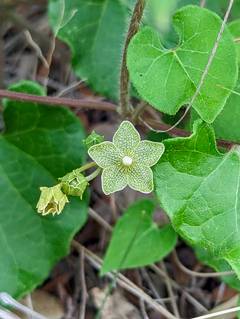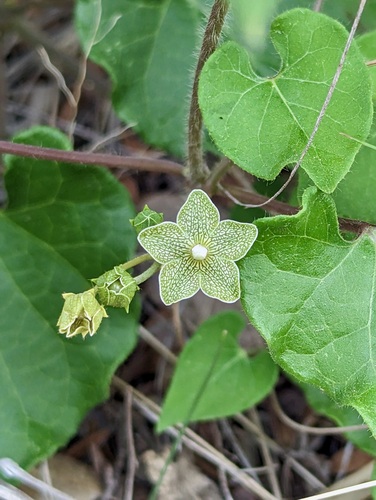
Matelea, Genus, spp., Multiple species,
- Genus
- Multiple species
milkvine
Southern United States to tropical South America
Overview
Matelea is a genus of roughly 200 twining vines in the dogbane family (Apocynaceae), placed in the milkweed subfamily and native to the warmer Americas. The stems are slender and twining, climbing 3–15 ft (1–4.5 m) through surrounding vegetation and exuding milky sap when cut. The paired leaves are usually heart-shaped, with a deep basal sinus. Star-shaped five-lobed flowers, roughly 0.25–0.75 in (6–20 mm) across, open in shades of maroon, brown, purple, and green; several species carry a faint carrion scent that draws flies and other small pollinators. Pollen is bundled into waxy packets called pollinia, typical of the milkweed group, and transferred whole between flowers. Fruit is a warty or winged follicle that splits to release flat seeds tipped with silky hairs, carried on the wind. Most species grow at woodland edges, in thickets, and on rocky slopes, dying back to perennial roots in cold winters. The milky sap contains cardenolide compounds and is bitter and mildly toxic if eaten. Several species have narrow ranges and are uncommon in the wild.
Native Range
Matelea is native to the Americas, ranging from the southern United States through Mexico and Central America to tropical South America. The greatest diversity is in Mexico.Suggested Uses
Grown on trellises, fences, and through shrubs in native and habitat gardens, mainly for the milkweed-family flowers and seed pods. Several species serve as larval or nectar plants for specialist insects. Rare species are kept in botanical and conservation collections.How to Identify
Appearance
Size & Dimensions
Height3' - 15'
Width/Spread2' - 6'
Bloom Information
Flowering runs through late spring and summer, varying with species and climate. The small star-shaped flowers open in dark maroon, brown, purple, or green and are pollinated by flies and small insects drawn to their scent. Follicles develop afterward and release tufted seeds in late summer and autumn.
Detailed Descriptions
Flower Description
maroon, brown, purple, or greenFoliage Description
greenGrowing Conditions
Sun Requirements
Requires 4-10 hours of direct sunlight daily
• Full Sun: 6+ hours of direct sunlight
• Partial Shade: 3-6 hours of direct sunlight
• Full Shade: Less than 3 hours of direct sunlight
Water & Climate
Water Needs
Drought Tolerance
Drought tolerant when established