Marchantia, Genus, polymorpha, Species,
- Genus & species
common liverwort
Cosmopolitan across temperate and boreal regions worldwide
SunFull Shade
WaterHigh
Overview
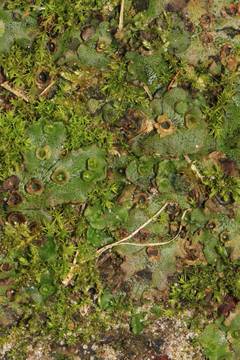
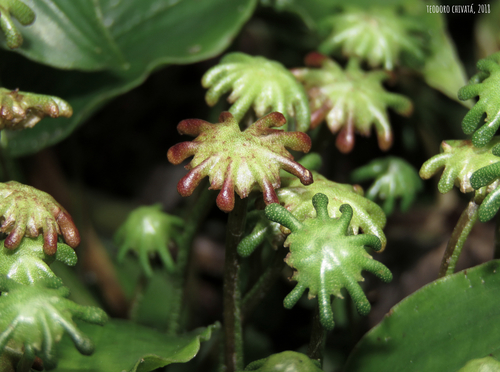
Marchantia polymorpha is a thallose liverwort forming flat, ribbon-like green mats pressed against the surface it grows on. The thallus is dichotomously branched, 0.8-4 inches (2-10 cm) long and 0.4-0.8 inch (1-2 cm) wide, with a leathery upper surface patterned into polygonal segments, each bearing a central pore over an internal air chamber, and a dark midrib beneath anchored by rootlike rhizoids. Cup-shaped receptacles (splash cups) on the upper surface hold green disc-like gemmae that rainfall scatters for asexual spread. The species is dioecious: male plants raise stalked, lobed disc-shaped receptacles 0.4-1.2 inches (1-3 cm) tall, while female plants bear umbrella-shaped receptacles with finger-like rays radiating from the top, within which spores ripen. Growth is rapid in cool, wet, nutrient-rich conditions, where mats overrun bare soil, paths, and container compost within weeks. The mats brown and shrivel under drought and direct sun and do not persist in dry exposure.
Native Range
Marchantia polymorpha has a near-cosmopolitan distribution across temperate and boreal regions of both hemispheres. It colonises moist, disturbed, often nutrient-rich ground such as streambanks, ditches, paths, burned sites, greenhouse benches, and nursery containers, favouring shaded, consistently damp surfaces.Suggested Uses
Grown in terraria, vivaria, and damp shade gardens as a ground-covering liverwort, and used in plant biology as a model organism for studying development and reproduction. In nursery and greenhouse settings it appears as a weed on container surfaces rather than a planted subject.How to Identify
Appearance
Size & Dimensions
Height1" - 2"
Colors
Foliage Colors
Bloom Information
As a liverwort, Marchantia polymorpha does not flower. It reproduces asexually by gemmae dispersed from splash cups whenever conditions stay moist, and sexually through stalked receptacles that develop mainly in spring and summer, releasing spores from the female receptacles in summer.
Detailed Descriptions
Foliage Description
greenGrowing Conditions
Sun Requirements
Tolerates up to 2 hours of direct sunlight daily
• Full Sun: 6+ hours of direct sunlight
• Partial Shade: 3-6 hours of direct sunlight
• Full Shade: Less than 3 hours of direct sunlight
Water & Climate
Water Needs
Care & Maintenance
Care Guide
Grows on consistently moist, shaded surfaces with high mineral nutrients, conditions common on overwatered container compost and greenhouse benches. It spreads fastest where standing moisture, low airflow, and surface fertiliser coincide, and is treated as a weed in nurseries for that reason. Mats lift away easily by hand from soil and pot surfaces. Reducing surface watering, increasing airflow, and topping pots with grit or gravel limit recolonisation. The plant tolerates cold but browns and dies back under drought or direct sun. No feeding is needed where it is grown deliberately in terraria and damp shade gardens.Pruning
No pruning applies. Unwanted mats are scraped or peeled from the surface by hand, before gemma cups and receptacles mature and release propagules. Removed material regrows from fragments if left on moist ground.Container Growing
Suitable for container growing