Marchantia, Genus, spp., Multiple species,
- Genus
- Multiple species
liverworts
SunPart Shade – Full Shade
WaterHigh
Overview
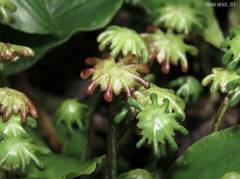
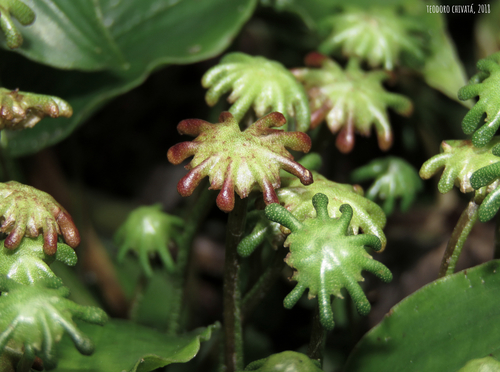
Marchantia is a genus of thalloid liverworts that form flat, ribbon-like green thalli pressed against the substrate. Individual thalli reach 0.4-4 inches (1-10 cm) long and 0.2-0.8 inch (5-20 mm) wide, branching repeatedly in a Y-shaped (dichotomous) pattern, with a central midrib and a surface divided into diamond-shaped polygons, each marked by a single central pore over an internal air chamber. The upper surface bears gemma cups 0.08-0.12 inch (2-3 mm) across holding green disc-shaped gemmae that splash out in raindrops to start new plants. These are non-vascular plants with no true roots, stems, leaves, wood, flowers, or seeds; thread-like rhizoids on the underside anchor the thallus and take up water. Sexual reproduction occurs on stalked umbrella-shaped receptacles that rise 0.4-1.2 inches (1-3 cm) above the thallus, the female receptacle bearing finger-like rays and the male a flattened disc. Spores ripen and release in late spring through summer. Mats spread horizontally by several centimeters per season under steady moisture. Foliage is uniformly green to dark green, sometimes purple-tinged along the margins in strong light. Thalli brown and curl during drought and green up again when rewetted. Across the genus, roughly three dozen species range from temperate to tropical regions, on wet soil, rock, streambanks, and recently burned ground.
Native Range
The genus Marchantia is cosmopolitan, occurring on every continent and on many oceanic islands. Species grow in moist, shaded habitats including streambanks, seepage slopes, wet rock faces, disturbed soil, and recently burned ground, from sea level to above 13,000 feet (4,000 m). M. polymorpha spreads with human disturbance worldwide and colonizes greenhouse soil, paths, and fire sites.Suggested Uses
Grown in terrariums, bottle gardens, and on moist rockwork and living walls where constant humidity is maintained. M. polymorpha serves as a laboratory model for studying land-plant evolution and gametophyte development. On nursery benches and in containers, the genus more often appears as a colonizer of persistently wet soil than as a deliberate planting.How to Identify
Appearance
Colors
Fall Foliage Colors
Reproduction
Marchantia reproduces by spores rather than flowers. Stalked male and female receptacles form in spring and early summer in temperate species, and spores release from the female receptacle over several weeks from late spring into mid-summer. In tropical and greenhouse populations, reproductive structures can appear at any time of year where moisture stays constant.
Detailed Descriptions
Foliage Description
green to dark green, purple-tinged at margins in strong lightGrowing Conditions
Sun Requirements
Tolerates up to 4 hours of direct sunlight daily
• Full Sun: 6+ hours of direct sunlight
• Partial Shade: 3-6 hours of direct sunlight
• Full Shade: Less than 3 hours of direct sunlight
Water & Climate
Water Needs
Care & Maintenance
Care Guide
Grows in consistently moist, shaded conditions; thalli desiccate and brown within hours in direct sun and dry air, then revive when moisture returns. Growth is sustained by humidity above 70 percent and a substrate kept damp, such as peat, clay soil, or wet rock in terrarium culture. Hard water leaves mineral deposits on the thallus surface, while low-mineral or rainwater keeps it clean. Bright indirect light maintains green coloration; deep shade slows growth and high light scorches the margins. Gemmae released from gemma cups root and form new thalli within 2-4 weeks on damp substrate. In gardens, Marchantia colonizes overwatered, poorly drained soil and the surface of container mixes, where it competes with seedlings for surface moisture.Pruning
No pruning is required, as Marchantia has no woody stems or true leaves. Unwanted growth is lifted off the substrate as a mat, or left to dry, which kills exposed thalli. Lower surface moisture and improved drainage reduce regrowth from residual gemmae.Container Growing
Suitable for container growing