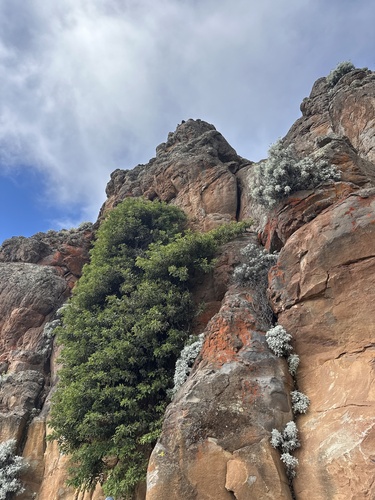
Malosma, Genus, laurina, Species,
- Genus & species
laurel sumac
Southern California and northern Baja California
Overview
Malosma laurina is an evergreen shrub or small tree reaching 6-20 feet (1.8-6 m) tall and about as wide, with many stems rising from the base into a rounded crown. Leaves are lance-shaped to oblong, 2-4 inches (5-10 cm) long, leathery, and folded upward along the reddish midrib, with a faint scent of bitter almond when crushed. New growth and leaf stalks are tinged red. Small whitish flowers are packed into branched terminal clusters 2-6 inches (5-15 cm) long from late spring through summer. These ripen to tiny whitish, single-seeded fruits about 0.1 inch (2-3 mm) wide that persist into winter. Growth is fast where water is available, and plants resprout from a woody basal burl after fire. Foliage is killed by temperatures below about 25 F (-4 C), which limits the plant to mild coastal and foothill zones.
Native Range
Native to southern California and northern Baja California, in coastal sage scrub and chaparral on slopes and canyons below about 3,000 feet (900 m). It often grows on deeper soils and near drainages where moisture lasts longer.Suggested Uses
Used in habitat restoration, erosion control on slopes, and large native plantings in southern California, spaced 8-12 feet (2.4-3.7 m) apart. Its size and frost sensitivity limit it to mild-climate, open settings rather than small gardens.How to Identify
Appearance
Size & Dimensions
Height6' - 20'
Width/Spread6' - 20'
Bloom Information
Detailed Descriptions
Foliage Description
green with red midribGrowing Conditions
Sun Requirements
Requires 6-12 hours of direct sunlight daily
• Full Sun: 6+ hours of direct sunlight
• Partial Shade: 3-6 hours of direct sunlight
• Full Shade: Less than 3 hours of direct sunlight
Care & Maintenance
Care Guide
Grows in full sun on well-drained slopes and tolerates sandy to clay soils. Water deeply but infrequently while young; established plants survive on winter rainfall and summer fog along the coast. It is sensitive to cold and dies back when temperatures drop below 25 F (-4 C), and was historically used as a marker for siting frost-tender citrus. Root rot develops with summer irrigation in heavy soil. After fire or cutting, plants regrow quickly from the basal burl. The fast growth and large size need room away from buildings.Pruning
Prune in late summer or fall to shape or reduce size; the shrub tolerates hard cutting and resprouts from the base. Thinning interior stems improves air movement and reduces dead wood. Pruned plants regrow quickly during the wet season.Pruning Schedule
Prune: August–September
summerfall