Macroptilium, Genus, lathyroides, Species,
- Genus & species
Phasey bean
Overview
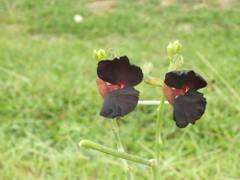
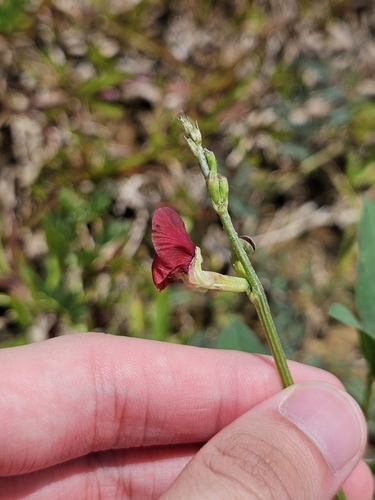
Macroptilium lathyroides is an erect to scrambling short-lived perennial legume growing 1-5 feet (0.3-1.5 m) tall, with slender, slightly hairy stems that may climb over nearby plants. The leaves are trifoliate, each leaflet narrow and lance-shaped to oblong, 1-3 inches (2.5-7.5 cm) long, mid green and sparsely hairy. From spring through autumn it bears pea-shaped flowers 0.4-0.6 inch (10-15 mm) long in deep red to purple, carried in pairs on long, wiry stalks held above the foliage. The flowers are followed by narrow cylindrical pods 2-4 inches (5-10 cm) long that ripen brown and split to scatter many seeds. As a legume it fixes nitrogen and grows quickly on disturbed, moist ground. Native to tropical America, Macroptilium lathyroides has naturalised across tropical and subtropical regions, including northern and eastern Australia, where it is treated as a pasture weed and a coloniser of roadsides and waste ground. It tolerates heat, humidity, and seasonal flooding but is killed by frost.
Native Range
Macroptilium lathyroides is native to tropical and subtropical America, from the southern United States through Central America and the Caribbean into South America. It has naturalised widely in Africa, Asia, and Australia, where it grows on disturbed, moist ground and is regarded as a weed of pastures and roadsides.Suggested Uses
M. lathyroides is grown as a forage legume, cover crop, and green manure in tropical and subtropical farming, where it adds nitrogen to the soil. Outside cultivation it colonises disturbed land and is listed as a weed in several regions. Its frost sensitivity confines field use to warm climates.How to Identify
Appearance
Size & Dimensions
Height1' - 5'
Width/Spread2' - 4'
Bloom Information
Red to purple pea flowers appear from spring through autumn and, in frost-free climates, almost year-round. Each pair of flowers sits on a long stalk well above the leaves. Bees and other insects work the flowers, after which slender pods form and shed seed.
Detailed Descriptions
Flower Description
Deep red to purpleFoliage Description
Mid greenGrowing Conditions
Sun Requirements
Requires 6-10 hours of direct sunlight daily
• Full Sun: 6+ hours of direct sunlight
• Partial Shade: 3-6 hours of direct sunlight
• Full Shade: Less than 3 hours of direct sunlight
Care & Maintenance
Care Guide
Grow M. lathyroides in full sun on moist, free-draining soil; as a legume it tolerates low fertility and improves soil nitrogen. The plant grows fast in warm, humid conditions but is killed by frost and behaves as an annual in cooler zones. It suits USDA zones 9-11 in cultivation as a forage or green-manure crop. Water to keep the soil moist during establishment, then reduce as plants mature. Because it self-seeds heavily and is invasive in many regions, pods can be cut before they ripen to limit spread.Pruning
M. lathyroides needs no formal pruning. Cutting or mowing before pods ripen prevents seed set and limits its spread as a weed. As a forage plant it regrows after grazing or slashing.Pruning Schedule
Prune: April–May
fall
Container Growing
Minimum container size: 3 gallons