Lysichiton, Genus, americanus, Species,
- Genus & species
swamp lanterns, skunk cabbage
Western North America — Alaska south through British Columbia, Washington, Oregon, and northern California, east across northern Idaho and western Montana; wetlands, stream banks, seeps, bog edges, and permanently saturated forest floor at low to mid elevations
Overview
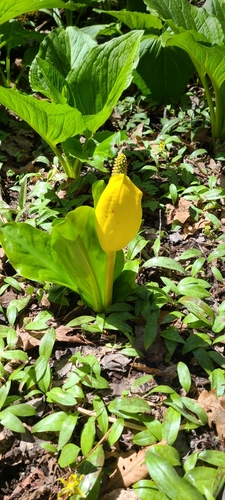
Lysichiton americanus is a large clumping deciduous herbaceous perennial in the family Araceae native to Pacific Northwest wetlands, growing 24-60 inches (60-150 cm) tall and 36-60 inches (90-150 cm) wide from a thick underground rhizome anchored in permanently saturated soil. The species produces its inflorescence in late winter from February through April, with a bright yellow spathe 4-8 inches (10-20 cm) tall emerging directly from the ground and surrounding a dense cylindrical green spadix 3-6 inches (7-15 cm) long packed with tiny individual flowers. The spathe emerges at a time when most other Pacific Northwest perennials remain dormant and pushes up through snow, frozen mud, or winter rain to produce one of the earliest blooms of any native plant in the region — the inflorescence is visible from considerable distance as a cluster of bright yellow flames glowing against the dark winter backdrop of bog and wet-forest habitats, and the common name swamp lantern refers directly to this visual effect. The spathe and spadix together emit a fetid skunk-like odor during the flowering period, and the odor is the species' adaptation to attract early-season pollinating flies, rove beetles, and other carrion-visiting insects that are active before most bees emerge from winter dormancy — the fetid smell is a functional feature of the pollination biology rather than a flaw, but it is also the reason the species is set back from seating areas and walking paths in garden plantings where prolonged exposure to the odor is undesirable. Enormous glossy dark-green paddle-shaped leaves expand from the rhizome after the spathe fades, reaching 24-60 inches (60-150 cm) long and 8-20 inches (20-50 cm) wide by midsummer and producing the largest leaves of any native herbaceous plant in the Pacific Northwest — a mature colony carries a canopy of leaves that rivals the scale of cultivated bog-garden exotics like Gunnera at a fraction of the tropical fussiness. The species is set apart from the eastern skunk cabbage (Symplocarpus foetidus) by the bright yellow spathe versus the dark purple-brown mottled spathe of the eastern species, and the two species do not overlap geographically in North America. All parts of the plant contain calcium oxalate raphides (needle-shaped crystals of calcium oxalate) that cause intense burning and swelling of the mouth, tongue, and throat if the raw plant is chewed or eaten, and additional irritation if the juice contacts skin or eyes; cooking breaks down the calcium oxalate crystals and Pacific Northwest Indigenous peoples have traditionally used the roasted rhizome and the young cooked leaves as famine food and medicine, but the raw plant is unsafe for humans and pets. Bears, elk, and deer eat portions of the plant without apparent harm, though most garden wildlife leaves it alone. The species was introduced to European gardens during the 19th century as an ornamental bog plant and has since escaped cultivation to become classified as a regulated invasive species in the United Kingdom, Ireland, and several continental European countries where it displaces native wetland vegetation — the species is prohibited from sale in the EU under the Invasive Alien Species Regulation. In its native Pacific Northwest range the plant is a valuable wetland indicator species and carries no invasive concerns. The central cultivation requirement is permanently wet to saturated soil: the rhizome cannot tolerate drying out and gardeners attempting to grow the species in merely moist garden beds find that the plant declines and dies within a single dry period, so the species is suited only to pond margins, stream banks, rain garden floors with natural seep irrigation, and purpose-built bog garden installations with continuous water supply.
Native Range
Lysichiton americanus is native to the wetlands of western North America, with a range spanning Alaska south through coastal and interior British Columbia, Washington, Oregon, and northern California and extending east across the Idaho Panhandle and western Montana. The species grows in permanently saturated habitats including bog floors, beaver-pond margins, seeps, slow-moving stream banks, and wet coniferous and deciduous forest understory, at low to mid elevations where the consistently wet soil and cool moist climate of the region match its cultivation requirements. The species is a valuable wetland indicator in its native range and carries no invasive concerns where it is native. European garden cultivation began in the 19th century when the species was introduced as an ornamental bog plant for large estate water features, and the species subsequently escaped cultivation and naturalized in wetlands across the United Kingdom, Ireland, Belgium, the Netherlands, Germany, Switzerland, and other temperate European countries. L. americanus is now classified as an invasive alien species in the European Union and is prohibited from sale, import, and cultivation under the EU Invasive Alien Species Regulation, and gardeners in Europe seeking a similar wetland plant are directed toward native alternatives rather than the North American species.Suggested Uses
Planted at pond margins, stream banks, bog garden floors, rain garden low points, wet woodland understory, and native wetland restoration plantings at 3-5 foot (0.9-1.5 m) spacing in zones 4-9 on permanently wet sites only. The combination of the bright yellow late-winter spathe and the enormous dark-green summer leaves gives the species a central role in Pacific Northwest native bog gardens where the scale and native provenance justify its space and where the permanent wet soil matches its requirements. Combined with other native wetland perennials including Caltha palustris (marsh marigold, a smaller yellow-flowered companion for the same late-winter-into-spring window), Darmera peltata (Indian rhubarb), native ferns (Athyrium filix-femina, Matteuccia struthiopteris), and sedge species in wetland plantings where the shared wet-soil requirements align and the companion plants fill in around the Lysichiton canopy. Not suited to European gardens where the species is prohibited as an invasive alien under EU regulation, dry or merely moist garden beds where the wet-soil requirement cannot be met, small residential gardens where the 5-foot leaf canopy overwhelms the available scale, formal plantings where the informal bog habitat conflicts with structured design, seating areas and walking paths where the fetid winter bloom odor is undesirable, or households where young children or pets might chew the raw plant and experience calcium oxalate raphide burning of the mouth and throat. European gardeners seeking a similar wetland plant are directed toward native alternatives such as the European Caltha palustris rather than the regulated North American species.How to Identify
Appearance
Size & Dimensions
Height2' - 5'
Width/Spread3' - 5'
Bloom Information
Bright yellow spathe 4-8 inches (10-20 cm) tall surrounding a dense cylindrical green spadix emerges directly from the ground during February, March, and April in zones 4-9, lasting approximately 6 weeks. The inflorescence pushes up through snow, frozen mud, or winter rain, producing one of the earliest blooms of any Pacific Northwest native plant and drawing attention from considerable distance as a cluster of bright yellow flames glowing against the dark winter backdrop of bog and wet-forest habitats. The spathe and spadix together emit a fetid skunk-like odor adapted to attract early-season pollinating flies, rove beetles, and other carrion-visiting insects that are active before most bees emerge from winter dormancy. After pollination the spathe fades and the spadix develops small green fruits that ripen through summer as the enormous leaves expand and dominate the plant's visible presence.
Detailed Descriptions
Flower Description
bright yellow spathe 4-8 inches (10-20 cm) tall surrounding a dense cylindrical green spadix 3-6 inches (7-15 cm) long packed with tiny individual flowers; the yellow spathe emerges directly from the ground in late winter, often pushing up through snow or freezing mud, and the combined spathe-and-spadix inflorescence emits a fetid skunk-like odor that attracts early-season pollinating flies and beetlesFoliage Description
glossy dark green; paddle-shaped to broadly ovate leaves 24-60 inches (60-150 cm) long and 8-20 inches (20-50 cm) wide rising directly from the underground rhizome on stout fleshy petioles; leaves emerge after the flowering spathe and expand progressively through spring and summer to full size, producing the largest leaves of any native herbaceous plant in the Pacific NorthwestGrowing Conditions
Sun Requirements
Requires 1-8 hours of direct sunlight daily
• Full Sun: 6+ hours of direct sunlight
• Partial Shade: 3-6 hours of direct sunlight
• Full Shade: Less than 3 hours of direct sunlight
Care & Maintenance
Care Guide
Plant in permanently wet to saturated soil with a pH of 5.0-7.0 in part shade to full sun (1-8 hours of direct sun), with full sun tolerated only where the soil remains consistently saturated through the summer season; tolerated soil types include clay, silt, and peat, and the species thrives in heavy organic mud that would kill most garden perennials. The species is not drought-tolerant and the rhizome cannot tolerate drying out — even a single summer dry period is frequently fatal, so the species is suited only to pond margins, stream banks, rain garden floors with natural seep irrigation, and purpose-built bog garden installations with continuous water supply, and gardeners attempting to grow the species in merely moist garden beds find that it declines and dies within the first dry spell. Allow space for the mature leaf canopy to reach 5 feet (1.5 m) across on a mature clump, and space plants 3-5 feet (0.9-1.5 m) apart to accommodate the full size without crowding neighbors. The fetid skunk-like odor during the late winter bloom is a functional feature of the pollination biology rather than a flaw, and the plant is set back from seating areas and walking paths in garden plantings where prolonged exposure to the odor is undesirable — the odor subsides after the spathe fades and the foliage period carries no fragrance. All parts of the plant contain calcium oxalate raphides (needle-shaped crystals of calcium oxalate) that cause intense burning and swelling of the mouth, tongue, and throat in humans and pets if the raw plant is chewed or eaten, and additional irritation if the juice contacts skin or eyes; cooking breaks down the raphides and Pacific Northwest Indigenous peoples have traditionally used the roasted rhizome and young cooked leaves as famine food and medicine, but the raw plant is unsafe and the species should not be treated as a casual edible. Deer avoid the foliage. European gardeners are advised that the species is classified as an invasive alien species in the EU and prohibited from sale and cultivation under the Invasive Alien Species Regulation — native alternatives are recommended for European wetland plantings.Pruning
Old dead foliage is cut to the ground in late winter (February) before the new spathe emerges, clearing the space for the emerging inflorescence and the new season's leaves. No other pruning is needed during the growing season — the species is a slow-growing long-lived bog plant with low maintenance demands once the site conditions match its wet-soil requirements. The underground rhizome is not disturbed or divided routinely; mature colonies are left in place for decades. Flowering spathes can be left to develop fruits or cut off after bloom if seed production is unwanted, though the species rarely self-sows to problematic levels in North American garden settings.Pruning Schedule
Prune: February
early spring