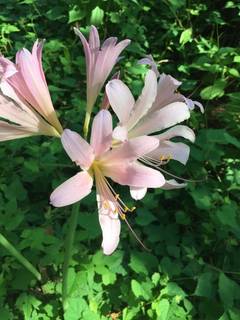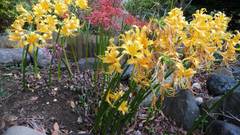
Lycoris, Genus, radiata, Species,
- Genus & species
red spider lily
Overview
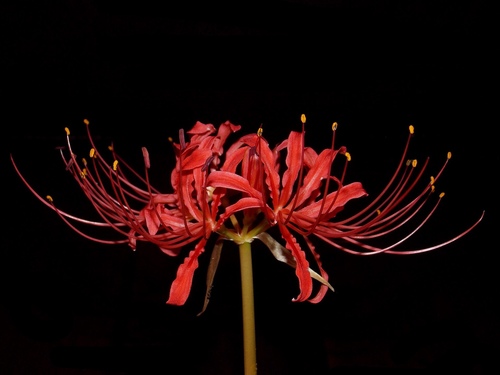
Lycoris radiata is a bulb-forming perennial in the amaryllis family, known for leafless flowering stems that appear suddenly in late summer and autumn ahead of the foliage. Each smooth, hollow scape rises 12-24 inches (30-60 cm) from the bulb and is topped by an umbel of four to seven bright red flowers, each with six narrow, strongly recurved and wavy-edged tepals and long, arching stamens that extend two to three times the length of the petals, giving the bloom a spidery look. The flowers open within days of the first cool rains, before any leaves show. After flowering, strap-shaped, dark green leaves about 0.5 inch (1 cm) wide emerge and persist through winter, then die back by late spring as the bulb goes dormant for summer. All parts, especially the bulb, contain lycorine and related alkaloids that are poisonous if eaten and can irritate skin. Native to China, Japan, and Korea, it has long been grown in the southeastern United States, where it naturalizes in old gardens, cemeteries, and roadside ditches. It increases by bulb offsets to form clumps over time and rarely sets seed. The leafless red flower stalks rising from bare ground make it unmistakable in autumn.
Native Range
Native to eastern Asia, including China, Japan, and Korea. It has been cultivated for centuries and is widely naturalized in the southeastern United States, where it persists in old home sites, cemeteries, and roadsides. It favors moist, partly shaded ground but tolerates a range of garden conditions.Suggested Uses
Lycoris radiata is used for autumn color in borders, woodland edges, and naturalized drifts beneath deciduous trees, and as a long-lived passalong bulb in southern gardens. Its leafless red flower stalks suit the front of beds and lawn edges where they rise unexpectedly in fall. The toxic bulbs are left alone by deer and rodents, suiting it to unfenced plantings.How to Identify
Appearance
Size & Dimensions
Height1' - 2'
Width/Spread6" - 1'
Bloom Information
Flowering comes in late summer to early autumn, often within days of the first cooling rains in August or September. The bright red umbels rise on bare stems and last about one to two weeks. Bloom is followed, not preceded, by the strap-like leaves, a habit shared with other surprise lilies.
Detailed Descriptions
Foliage Description
dark greenGrowing Conditions
Sun Requirements
Requires 4-8 hours of direct sunlight daily
• Full Sun: 6+ hours of direct sunlight
• Partial Shade: 3-6 hours of direct sunlight
• Full Shade: Less than 3 hours of direct sunlight
Care & Maintenance
Care Guide
Lycoris radiata grows in full sun to part shade on moist, well-drained soil rich in organic matter, with a pH near neutral. Bulbs are set in place during summer dormancy with the neck at or just below the surface and left undisturbed, since they flower poorly after being moved. It is hardy in USDA zones 6-10 and benefits from a winter mulch at the cold edge of that range. The plant wants moisture during autumn bloom and winter leaf growth, then a drier rest in summer. Clumps bloom more freely when left crowded for several years before dividing in summer. All parts are toxic if eaten, which leaves the bulbs untouched by deer, rodents, and voles.Pruning
No pruning is needed beyond removing spent flower stalks after bloom. The winter foliage is left to grow until it yellows naturally in spring, as it feeds the bulb for the next season. Cutting the leaves early weakens future flowering.Container Growing
Suitable for container growing
Minimum container size: 2 gallons