Linnaea, Genus, borealis, Species,
- Genus & species
twinflower
Circumboreal — Alaska south through British Columbia, Washington, Oregon, and into California; east across Canada; northern Europe and Asia; moist conifer and boreal forests
Overview
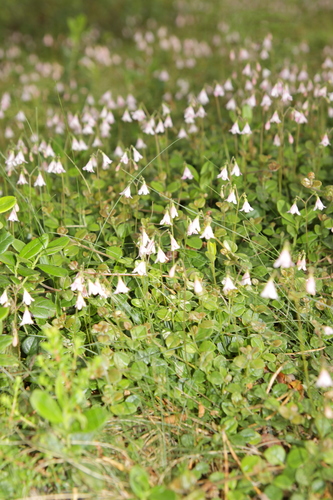
Linnaea borealis is twinflower (northern twinflower), a low trailing evergreen perennial ground cover growing 2-4 inches (5-10 cm) tall and 12-36 inches (30-90 cm) wide. Pale pink to white nodding bell-shaped sweetly fragrant flowers 0.3-0.5 inch (8-13 mm) ALWAYS in pairs on Y-shaped forked stalks in June-July (5 weeks) — the invariably paired flowers are diagnostic and the sole source of the common name. Dark green small opposite rounded leaves on slender wiry prostrate stems forming a slowly spreading mat. In Linnaeaceae. Borealis = northern. Linnaea is the only species in its genus, named by Carl Linnaeus after himself — his personal favorite plant. Native to circumboreal regions — Alaska south through BC, WA, OR, CA, east across Canada, and through northern Europe and Asia. Found in moist conifer and boreal forests, often beneath old-growth Douglas-fir, hemlock, and spruce. Cool moist shaded conditions with very acidic peaty soil are essential — famously challenging to establish in warm lowland gardens. Spreads slowly by horizontal rooting stems. Deer-resistant. Non-toxic. A characteristic indicator species of intact PNW old-growth conifer forest floor. Zones 2-7. Full shade. Growth rate is slow.
Native Range
Circumboreal — Alaska south through British Columbia, Washington, Oregon, and into California; east across Canada; northern Europe and Asia. Found in moist conifer and boreal forests, often beneath old-growth Douglas-fir, hemlock, and spruce.Suggested Uses
Grown as a delicate native ground cover in cool moist shaded forest gardens, native plant gardens, and old-growth-style PNW plantings, spaced 12-36 inches (30-90 cm). Paired flowers. Linnaeus's favorite plant. Difficult to establish. Non-toxic. Zones 2-7.How to Identify
Appearance
Size & Dimensions
Height2" - 4"
Width/Spread1' - 3'
Bloom Information
Summer (June-July). Pale pink to white nodding bell-shaped flowers 0.3-0.5 inch (8-13 mm) ALWAYS in pairs on Y-shaped forked stalks. Sweetly fragrant. 5 weeks. Bee-visited.
Detailed Descriptions
Flower Description
Pale pink to white nodding bell-shaped flowers 0.3-0.5 inch (8-13 mm); ALWAYS in pairs on Y-shaped forked stalks 2-4 inches (5-10 cm) tall — the invariably paired flowers are diagnostic and the source of the common name 'twinflower'; sweetly fragrant; June-JulyFoliage Description
Dark green, small opposite rounded to oval evergreen leaves 0.2-0.5 inch (5-13 mm) with a few small teeth near the tip; slender wiry prostrate stems form a slowly spreading matGrowing Conditions
Sun Requirements
Tolerates up to 2 hours of direct sunlight daily
• Full Sun: 6+ hours of direct sunlight
• Partial Shade: 3-6 hours of direct sunlight
• Full Shade: Less than 3 hours of direct sunlight