Leycesteria, Genus, spp., Multiple species,
- Genus
- Multiple species
Himalayan honeysuckle
Overview
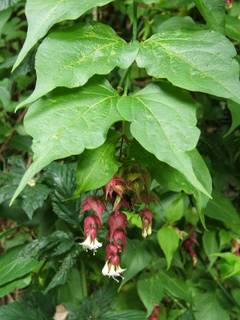
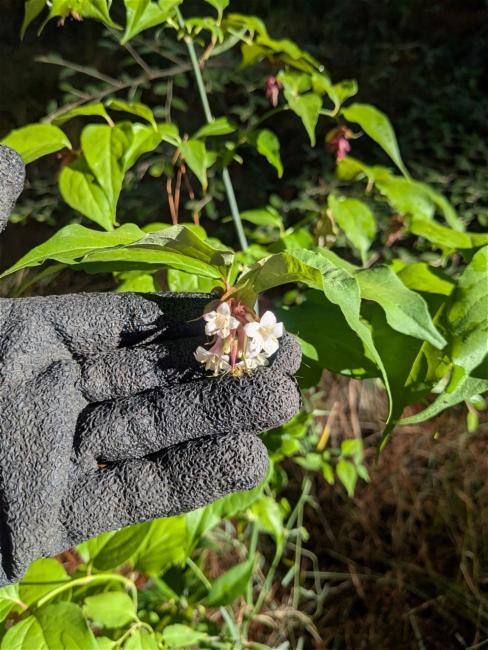
Leycesteria is a genus of about six deciduous shrubs in the honeysuckle family (Caprifoliaceae), native to the Himalayas and southwestern China. The most cultivated species, L. formosa, forms upright clumps of hollow, cane-like blue-green stems 4-6 ft (1.2-1.8 m) tall and 3-6 ft (0.9-1.8 m) wide that often die back in cold winters and resprout from the base. Leaves are opposite, heart-shaped to lance-shaped, 2-7 in (5-18 cm) long, dark green with a pointed tip. From summer into autumn, pendent terminal racemes 2-4 in (5-10 cm) long carry small white to pale-pink flowers nearly hidden by claret to wine-purple bracts. These are followed by soft, dark purple-black berries 0.3 in (8 mm) across that birds eat and disperse. Self-sown seedlings appear readily, and L. formosa is classed as an environmental weed in parts of New Zealand and Australia. Stems are short-lived, and the clump relies on continual basal renewal.
Native Range
Leycesteria is native to the Himalayan region, including Nepal, northern India, Bhutan, and Myanmar, and to southwestern China, where species grow on moist forest margins, clearings, and ravines. L. formosa has naturalized beyond this range in mild-climate areas of New Zealand, Australia, and western Europe.Suggested Uses
Leycesteria is used in mixed and shrub borders, woodland edges, and wildlife plantings where its summer flowers and autumn berries feed birds. It is spaced 4-5 ft (1.2-1.5 m) apart and combines with late perennials. In frost-prone gardens it is grown as a cut-back clump renewed each spring.How to Identify
Appearance
Size & Dimensions
Height4' - 6'
Width/Spread3' - 6'
Bloom Information
Flowering runs from early summer into autumn, roughly June to October, over a long season on the current year stems. Pendent racemes of white to pink flowers are framed by claret-purple bracts that persist as the purple-black berries ripen. Overlapping flowers and fruit extend the display into the first frosts.
Detailed Descriptions
Flower Description
White to pale pink with claret-purple bractsFoliage Description
Dark greenGrowing Conditions
Sun Requirements
Requires 4-8 hours of direct sunlight daily
• Full Sun: 6+ hours of direct sunlight
• Partial Shade: 3-6 hours of direct sunlight
• Full Shade: Less than 3 hours of direct sunlight
Care & Maintenance
Care Guide
Leycesteria grows in full sun to part shade in most fertile, moisture-retentive soils across a pH range of 5.5-7.5. Stems often die back in zone 6-7 winters and are cut to the ground in spring, after which the clump resprouts and flowers the same year. Hardiness spans USDA zones 6-9, with top growth surviving only in the milder part of that range. Plants spread by suckers and self-sown seed, which calls for seedling removal where naturalizing is a concern. Growth is fast and may need thinning to relieve congestion. Established clumps tolerate short dry spells but flower more freely with summer moisture.Pruning
Leycesteria is cut back hard in early spring, with stems reduced to 4-6 in (10-15 cm) above ground, since flowers form on new growth. In milder areas where stems survive, the oldest canes are thinned to the base to relieve congestion. Spent fruiting stems may be removed to limit self-seeding.Container Growing
Suitable for container growing
Minimum container size: 5 gallons