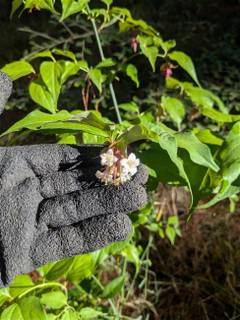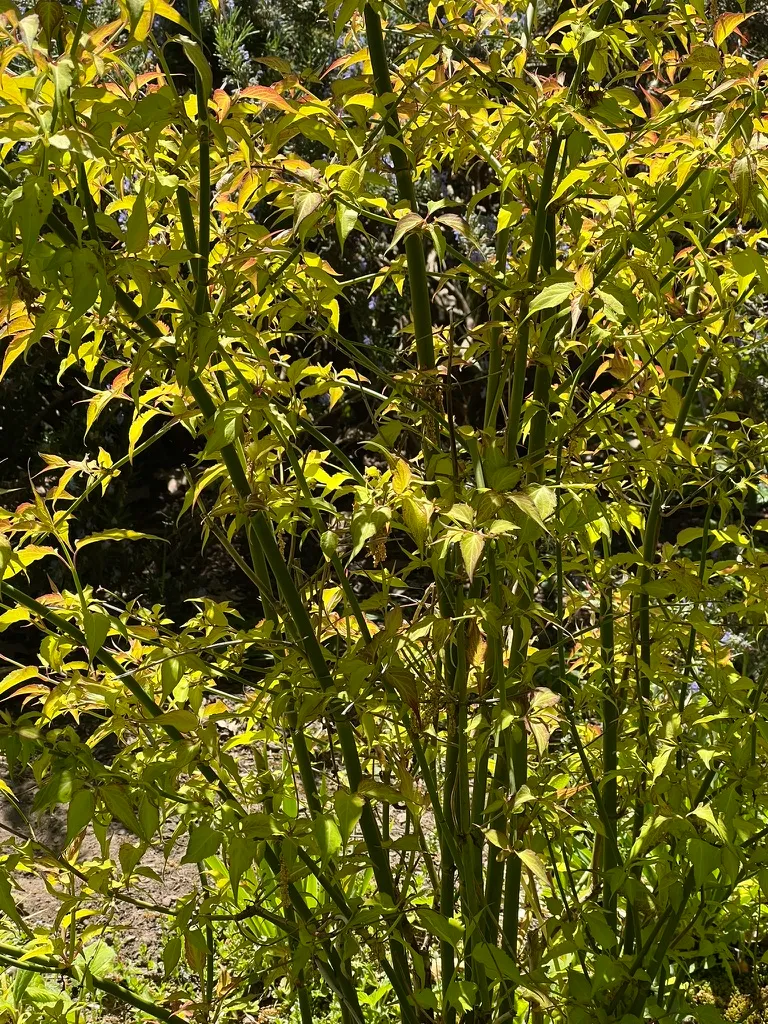
Image 1 of 4
1 / 4
Plant Reference
Leycesteria, Genus, formosa, Species,
- Genus & species
Himalayan honeysuckle
Himalayas and southwestern China from Pakistan through Nepal to Yunnan and Sichuan; forest margins and stream banks at 3,000-10,000 feet (900-3,000 m) elevation; the species is classified as invasive in New Zealand, southeastern Australia, and parts of the United Kingdom
Overview
Leycesteria formosa is an upright deciduous shrub in the family Caprifoliaceae native to the Himalayas and southwestern China, reaching 5-8 feet (1.5-2.4 m) tall and 4-6 feet (1.2-1.8 m) wide with hollow green bamboo-like stems that remain visible through the winter even after the leaves drop. Leaves are ovate, 2-7 inches (5-18 cm) long with a long tapered tip and heart-shaped base, and medium to dark green with a slight bluish cast. White to pale pink small tubular flowers 0.5-0.75 inch (1.3-2 cm) long open in pendant racemes 2-4 inches (5-10 cm) long from July through October — the long 12-week bloom period and the conspicuous dark purple-red bracts subtending each flower cluster together carry the main ornamental interest of the species. Dark purple-black berries 0.3 inch (8 mm) across ripen within the persistent purple-red bracts in late summer and fall and are eaten by birds, which disperse the seeds into surrounding habitats. The species is classified as invasive in New Zealand, southeastern Australia, and parts of the United Kingdom, where bird-dispersed seedlings have established populations in moist forest margins, streamsides, and disturbed open ground outside of garden cultivation; local invasive-species regulations govern whether the species is legal to plant in these regions. In the Pacific Northwest the species has naturalized in limited areas without being formally listed. The species is not drought-tolerant and requires consistent moisture through summer — sites with dry summer soils produce stunted plants with reduced flowering. In zone 7 the above-ground stems sometimes die back to the ground in hard winters and the plant regrows from the crown and roots in spring, still flowering on new wood within the same season. Growth is fast — a coppiced plant reaches 5-8 feet (1.5-2.4 m) within a single growing season.
Native Range
Leycesteria formosa is native to the Himalayas and southwestern China, with a range extending from Pakistan through Nepal and Bhutan east into Yunnan and Sichuan provinces of China. The species grows at forest margins, along stream banks, and on open moist slopes at 3,000-10,000 feet (900-3,000 m) elevation. Outside of its native range the species has been widely planted as an ornamental since the 19th century and has naturalized in New Zealand, parts of southeastern Australia, and parts of the United Kingdom, where it is classified as invasive.Suggested Uses
Planted in woodland gardens, moist mixed borders, stream-side positions, and wildlife gardens at 4-6 foot (1.2-1.8 m) spacing in zones 7-9. The long July-through-October bloom period, the contrast between white flowers and dark purple-red bracts, and the persistent bracts through winter make the species a late-season flowering feature in shaded and partly shaded moist positions where many other flowering shrubs have already finished. Combined with Hydrangea quercifolia, Rodgersia species, and ferns in moist woodland plantings where the water needs and light preferences align. Not suited to the Pacific Northwest adjacent to natural areas where the species has shown naturalization potential, jurisdictions in New Zealand, southeastern Australia, or parts of the United Kingdom where the species is regulated as invasive, dry-summer positions where moisture stress stunts growth, or landscapes where the annual coppicing pruning schedule is not practical.How to Identify
Appearance
Size & Dimensions
Height5' - 8'
Width/Spread4' - 6'
Bloom Information
White to pale pink small tubular flowers 0.5-0.75 inch (1.3-2 cm) long open in pendant racemes 2-4 inches (5-10 cm) long from July through October in zones 7-9, lasting approximately 12 weeks. Flowers are visited by bees, bumblebees, and butterflies and each raceme is subtended by conspicuous dark purple-red bracts that persist on the plant after the flowers drop. Dark purple-black berries 0.3 inch (8 mm) across ripen within the persistent bracts in late summer and fall and are eaten by birds, including game birds, which is the source of the common name 'pheasant berry'.
Detailed Descriptions
Flower Description
white to pale pink small tubular flowers 0.5-0.75 inch (1.3-2 cm) long borne in pendant racemes 2-4 inches (5-10 cm) long with conspicuous dark purple-red bracts subtending each flower clusterFoliage Description
medium to dark green with a slight bluish cast; ovate leaves 2-7 inches (5-18 cm) long with a long tapered tip and heart-shaped base; turns yellow before dropping in fallGrowing Conditions
Sun Requirements
Requires 4-8 hours of direct sunlight daily
• Full Sun: 6+ hours of direct sunlight
• Partial Shade: 3-6 hours of direct sunlight
• Full Shade: Less than 3 hours of direct sunlight
Care & Maintenance
Care Guide
Plant in moist well-drained soil with a pH of 5.5-7.5 in part sun to partial shade; tolerated soil types include loam, clay, and sand. Consistent summer moisture is needed because the species is not drought-tolerant and dry sites produce stunted plants with reduced flowering and early leaf senescence. Water weekly through summer in any rainfall-deficit period. The species self-sows prolifically in moist mild maritime climates, and bird-dispersed seedlings establish in nearby garden beds and adjacent natural areas; removal of volunteer seedlings as they appear is routine maintenance. The species is classified as invasive in New Zealand, southeastern Australia, and parts of the United Kingdom, and local invasive-species regulations govern whether the species is legal to plant in these regions. In zone 7 the above-ground stems sometimes die back to the ground in hard winters and the plant regrows from the crown and roots in spring, flowering on new wood within the same season. Pruning is done by coppicing in late winter (February-March).Pruning
The routine pruning method is coppicing — all above-ground stems are cut to within 6 inches (15 cm) of ground level in late winter (February through March) every year. The plant regrows 5-8 feet (1.5-2.4 m) from the crown and roots within a single growing season and blooms on the current year's new wood through the summer and fall. Annual coppicing keeps the interior of the plant open, prevents the tangled mass of dead stems that develops on unpruned specimens, and reliably produces flowering wood each year. Volunteer seedlings around the parent shrub are removed at their point of origin during the same pruning visit to limit self-seeded spread.Pruning Schedule
Prune: February–March
early spring
Container Growing
Minimum container size: 10 gallons