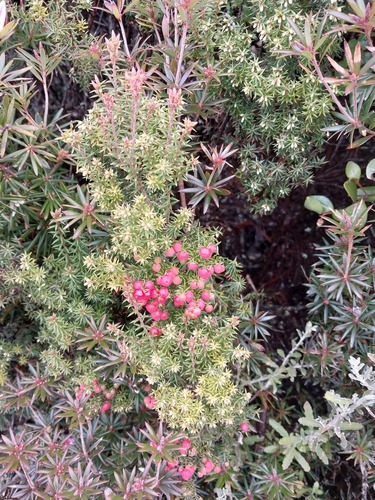
Leptecophylla, Genus, parvifolia, Species,
- Genus & species
mountain pinkberry
Tasmania and south-eastern Australia
Overview
Leptecophylla parvifolia is a small evergreen heath shrub in the family Ericaceae, growing 12-60 inches (30-150 cm) tall and 12-40 inches (30-100 cm) wide, with a dense, much-branched, upright to spreading form. The stiff, narrow leaves are 0.2-0.5 inch (5-13 mm) long, crowded along the stems, dark green above with pale parallel veins beneath and a sharp point. Small white tubular flowers about 0.2 inch (5 mm) long open singly or in small groups in the leaf axils, mainly in spring. The flowers are followed by rounded fleshy berries 0.2-0.3 inch (5-8 mm) wide that ripen pink to deep red and have a mild sweet flesh over a hard stone. Growth is slow, and plants take several years to reach full size. The species needs cool, moist, free-draining conditions and is sensitive to heat, drought, and poor drainage.
Native Range
Native to Tasmania and parts of south-eastern mainland Australia, where it grows in montane and subalpine heath, open forest, and rocky slopes. It occurs on cool, moist, acidic soils, often at higher elevations.Suggested Uses
Used in cool-climate native gardens, rockeries, and alpine plantings on acidic soils, spaced 24-36 inches (60-90 cm) apart. The edible pink-red berries are eaten fresh and draw birds. Suits containers in cool areas with a free-draining, acidic mix.How to Identify
Appearance
Size & Dimensions
Height1' - 5'
Width/Spread1' - 3'4"
Bloom Information
Small white tubular flowers open mainly in spring (September to November), sometimes into early summer at higher elevations. The flowers are short-lived but appear over several weeks. Pink to red berries ripen through summer and into autumn.
Detailed Descriptions
Foliage Description
dark greenGrowing Conditions
Sun Requirements
Requires 4-8 hours of direct sunlight daily
• Full Sun: 6+ hours of direct sunlight
• Partial Shade: 3-6 hours of direct sunlight
• Full Shade: Less than 3 hours of direct sunlight
Care & Maintenance
Care Guide
Grows in full sun to part shade on cool, moist, acidic soils with sharp drainage, reflecting its montane origins. It needs steady moisture and resents heat, drought, and waterlogged ground, performing poorly in warm lowland gardens. Light watering in dry spells and a cool root run from mulch or rock help it persist. The species needs no high-nutrient feeding and suits only low-phosphorus native fertilizer. Growth is slow, so plants take several years to fill out. Root-rot fungi are the main cause of loss on heavy or warm soils.Pruning
Light tip pruning after flowering keeps the shrub dense and compact. The plant reshoots slowly from older wood, so hard pruning is avoided. Removing dead or frost-damaged stems tidies the plant without affecting fruiting.Pruning Schedule
Prune: December
summer
Container Growing
Suitable for container growing
Minimum container size: 5 gallons