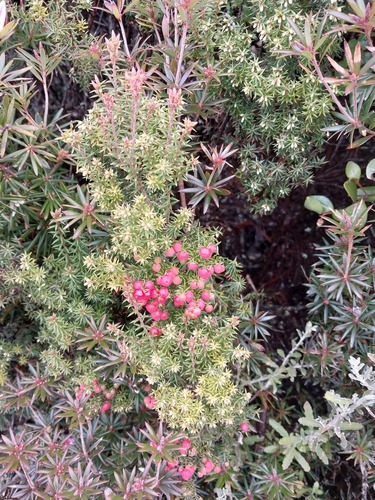
Leptecophylla, Genus, spp., Multiple species,
- Genus
- Multiple species
pink mountain berry
Australia, New Zealand, and Pacific islands
Overview
Leptecophylla is a genus of about ten evergreen shrubs in the heath family (Ericaceae), native to Australia, including Tasmania, New Zealand, and islands of the Pacific as far as Hawaii. Plants form small to medium shrubs 0.3-3 m (1-10 ft) tall, with stiff, narrow, sharply pointed leaves arranged closely along the stems, often grey-green and marked with parallel veins beneath. The small flowers are white to pink, tubular to urn-shaped, and hang singly or in short clusters in the leaf axils. They are followed by rounded fleshy drupes in white, pink, or red, which are edible and mildly sweet in several species. L. juniperina, the pink mountain berry, is a widespread species of cool temperate Australia. The genus grows in heath, montane scrub, forest understorey, and exposed coastal and alpine sites, on acidic, often poor soils. Plants are slow-growing and adapted to nutrient-poor conditions, with the sharp foliage deterring browsing. Most species need cool, moist but well-drained acidic ground and are intolerant of both drought and waterlogging, which can make them short-lived in unsuitable gardens.
Native Range
Leptecophylla is native to Australia, including Tasmania, New Zealand, and Pacific islands extending to Hawaii and the Marquesas. Plants grow in heath, montane and alpine scrub, forest understorey, and coastal sites on acidic soils.Suggested Uses
Grown in cool-climate native gardens, rockeries, and heath plantings, and used informally as a low hedge where the prickly foliage limits access. The edible berries of L. juniperina are eaten fresh or in preserves. Plants are spaced 0.5-1 m (1.5-3 ft) apart.How to Identify
Appearance
Size & Dimensions
Height1' - 10'
Width/Spread1' - 6'
Colors
Bloom Information
Flowering occurs mainly in late winter and spring, with timing varying across the wide range. The small tubular flowers open over several weeks and give way to the rounded drupes through summer and autumn. In some species flowers and ripe fruit appear together.
Detailed Descriptions
Flower Description
white to pinkFoliage Description
grey-greenGrowing Conditions
Sun Requirements
Requires 4-8 hours of direct sunlight daily
• Full Sun: 6+ hours of direct sunlight
• Partial Shade: 3-6 hours of direct sunlight
• Full Shade: Less than 3 hours of direct sunlight
Care & Maintenance
Care Guide
Plants grow in full sun to part shade and require acidic, well-drained soil that stays cool and lightly moist. Like many heath-family plants they are sensitive to phosphorus and to lime, so neutral or alkaline soils are unsuitable. Establishment is slow, and plants are propagated from seed or cuttings with variable success. Drought and waterlogging both cause decline, so a soil that holds even moisture without staying wet is needed. Frost hardiness varies, with alpine and Tasmanian species tolerating hard frost and island species being more tender.Pruning
A light trim after fruiting keeps plants dense without cutting into bare wood, which is slow to reshoot. Dead or damaged stems can be removed at any time. The sharp-pointed leaves make heavy pruning awkward.Container Growing
Suitable for container growing
Minimum container size: 3 gallons
