Leontodon, Genus, hispidus, Species,
- Genus & species
rough hawkbit
Overview
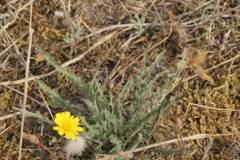
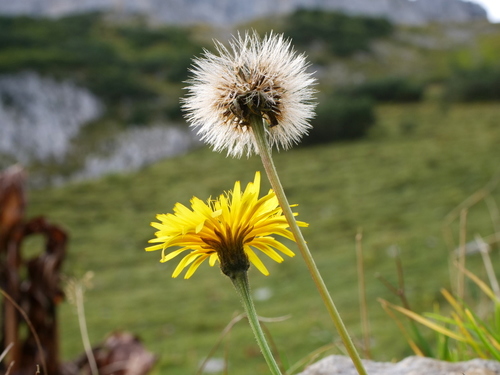
Leontodon hispidus is a perennial in the daisy family, forming a flat basal rosette of oblong leaves with shallow, wavy-toothed lobes and a covering of stiff, forked bristly hairs that give the plant its rough texture. From the rosette rise leafless, unbranched flowering stalks 4-16 inches (10-40 cm) tall, each topped by a single dandelion-like flower head 1-1.5 inches (25-35 mm) across made up entirely of golden-yellow ray florets. The outer florets are often tinged orange or reddish on the underside. Unlike true dandelions, the flower stalk is solid rather than hollow and carries scattered hairs. After flowering, the heads form spherical clocks of feathery, parachute-borne seeds that disperse on the wind. The plant has a deep taproot that anchors it in thin soils and lets it withstand drought and grazing. Native to Europe and western Asia, it is a characteristic plant of old hay meadows, chalk grassland, road verges, and dunes. It tolerates mowing and trampling, regrowing from the rosette, though it declines where taller, more vigorous vegetation shades it out.
Native Range
Native to Europe and western Asia, from Britain and Scandinavia to the Mediterranean and the Caucasus. It grows in unimproved grassland, chalk downs, meadows, road verges, and coastal dunes, usually on neutral to calcareous soils.Suggested Uses
Used in wildflower meadows, chalk grassland restoration, and naturalistic lawns managed for biodiversity. It supports pollinators and combines with other meadow perennials and grasses in low-input plantings.How to Identify
Appearance
Size & Dimensions
Height4" - 1'4"
Width/Spread6" - 10"
Bloom Information
Flowers from early summer to early autumn, mainly June to September, with each head opening on a sunny morning and closing by afternoon. Heads are borne in succession over a long season. Bees and hoverflies visit the open heads for pollen and nectar.
Detailed Descriptions
Foliage Description
greenGrowing Conditions
Sun Requirements
Requires 6-12 hours of direct sunlight daily
• Full Sun: 6+ hours of direct sunlight
• Partial Shade: 3-6 hours of direct sunlight
• Full Shade: Less than 3 hours of direct sunlight
Care & Maintenance
Care Guide
Grows in full sun on free-draining neutral to alkaline soils, including thin chalk, sand, and gravel. It withstands drought through its deep taproot and tolerates low fertility, declining where rich soils favor coarse grasses. In a lawn or meadow it survives regular mowing, regrowing from the flattened rosette. It needs no feeding or irrigation once established and resents waterlogged ground. Plants spread only by seed, not by runners, so spread is gradual and easily controlled.Pruning
No pruning is needed. In a managed meadow, an annual late-summer cut after seed has set maintains the open sward it depends on. Spent flower stalks can be removed to limit self-seeding in borders.Pruning Schedule
Prune: August–September
summerfall