Lapageria, Genus, rosea, Species,
- Genus & species
Chilean bellflower
Overview
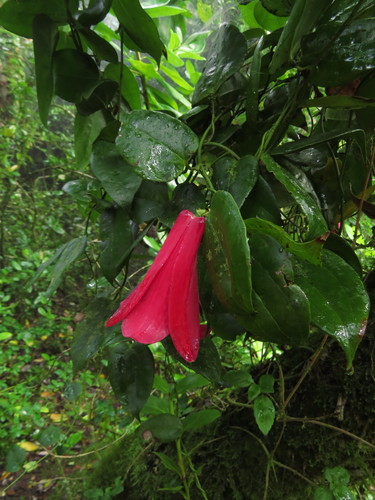
Lapageria rosea is an evergreen twining climber in its own small family, reaching 10–15 feet (3–4.5 m) where supported and growing slowly to that height over many years. The wiry stems twine through shrubs and trellis, carrying leathery, dark green, oval leaves 2–4 inches (5–10 cm) long. From summer into autumn it bears pendulous, waxy, bell-shaped flowers 3–4 inches (8–10 cm) long, usually deep rose-red, with thick fleshy petals in six segments; pink and white forms also occur. Fleshy berries follow pollinated flowers. The plant is native to cool, humid forest and needs shade, steady moisture, and acidic, free-draining soil. It is tender, damaged below about 23°F (−5°C), and grown under glass or in mild, frost-free gardens. Growth is slow and the roots are sensitive to disturbance, so plants establish gradually. Dry air, alkaline soil, and direct sun all check its growth.
Native Range
Lapageria rosea is native to the temperate rainforests of central and southern Chile, where it climbs through the forest understory. It is the national flower of Chile and grows in cool, humid, shaded conditions.Suggested Uses
Lapageria rosea is used on shaded walls, trellis, and pergolas in mild gardens, and in containers under glass in colder areas, where the stems climb 10–15 feet (3–4.5 m). It combines with other shade-tolerant climbers and woodland shrubs. Its tenderness and slow growth make it a long-term plant rather than quick cover.How to Identify
Appearance
Size & Dimensions
Height10' - 15'
Width/Spread3' - 6'
Bloom Information
Detailed Descriptions
Foliage Description
Dark greenGrowing Conditions
Sun Requirements
Tolerates up to 4 hours of direct sunlight daily
• Full Sun: 6+ hours of direct sunlight
• Partial Shade: 3-6 hours of direct sunlight
• Full Shade: Less than 3 hours of direct sunlight
Care & Maintenance
Care Guide
Lapageria rosea grows in partial to full shade and cool, moist, acidic soil that drains freely, with a pH between 5.0 and 6.5. It needs steady moisture and humidity and declines in dry air, alkaline soil, or direct sun. It is tender, damaged below about 23°F (−5°C), so it is grown under glass or against a sheltered wall in mild gardens. The wiry stems need support to twine through. The roots are sensitive to disturbance, so it is left in place once planted. Slugs and snails feed on the young shoots.Pruning
Little pruning is needed. Dead or weak stems can be removed after flowering, and overlong stems can be shortened to fit the support. The slow growth means hard pruning is slow to be replaced and is usually avoided.Pruning Schedule
Prune: November
fall
Container Growing
Suitable for container growing
Minimum container size: 5 gallons