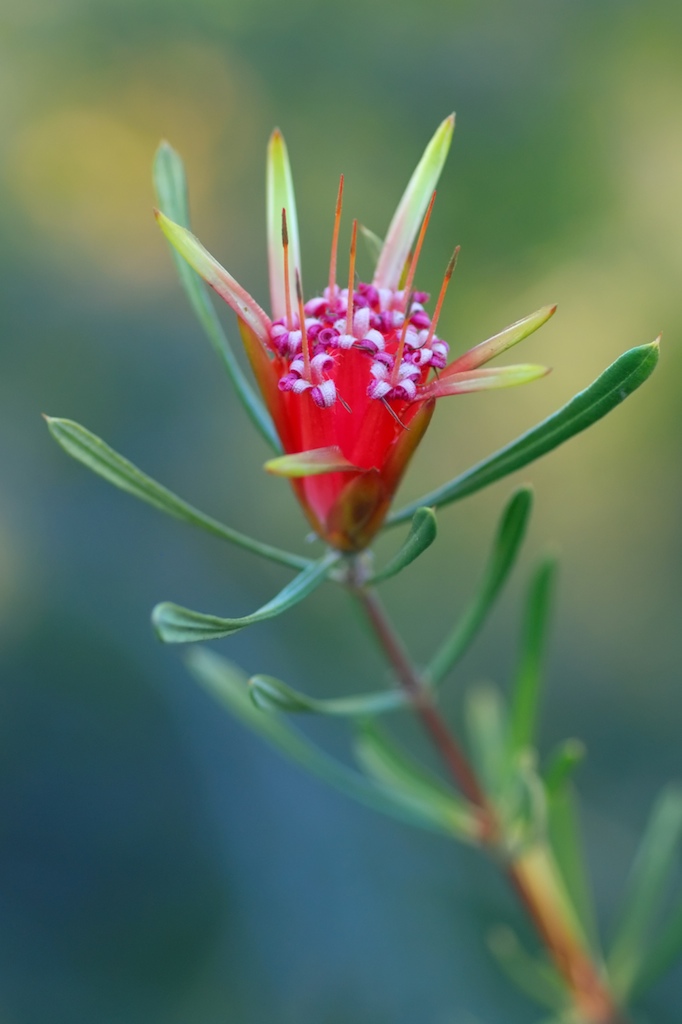
Lambertia, Genus, formosa, Species,
- Genus & species
mountain devil
Overview
Lambertia formosa is an erect shrub in the family Proteaceae, growing 3-6.5 feet (1-2 m) tall and occasionally to 10 feet (3 m), with stiff, narrow leaves 0.8-1.4 inches (2-3.5 cm) long arranged in whorls of three. The leaves are dark green above, paler beneath, with a sharp point and recurved margins. Clusters of about seven tubular red flowers, each 1-1.6 inches (2.5-4 cm) long, are held at the branch tips, rich in nectar and pollinated by honeyeaters. Flowering occurs through much of the year with a peak in spring. The flowers are followed by woody two-horned seed follicles that resemble a horned face, the source of the common name. It grows in heath and open woodland on sandstone soils around Sydney and the central coast of New South Wales. The plant is adapted to low-nutrient, free-draining ground and is sensitive to phosphorus. It tolerates drought and regenerates after fire from seed and a woody base. Growth is slow, and the stiff, prickly foliage makes the shrub difficult to handle. In rich or poorly drained soil the plant is short-lived.
Native Range
Lambertia formosa is native to New South Wales, where it grows on sandstone soils in heath and open woodland around Sydney, the Blue Mountains, and the central coast. It is restricted to low-nutrient, free-draining sites.Suggested Uses
Grown in native, coastal, and habitat gardens as a nectar source for honeyeaters, and as a low informal screen on sandy soils. It suits sandstone rockeries and dry, sunny banks. The prickly foliage forms a barrier planting that limits access.How to Identify
Appearance
Size & Dimensions
Height3' - 10'
Width/Spread3' - 6'6"
Bloom Information
Tubular red flowers appear through much of the year, with the heaviest flush in spring, roughly September to November in the native range. The nectar-rich blooms draw honeyeaters. Woody horned follicles develop after flowering and persist on the branches.
Detailed Descriptions
Foliage Description
dark greenGrowing Conditions
Sun Requirements
Requires 5-9 hours of direct sunlight daily
• Full Sun: 6+ hours of direct sunlight
• Partial Shade: 3-6 hours of direct sunlight
• Full Shade: Less than 3 hours of direct sunlight
Care & Maintenance
Care Guide
Grow in full sun to light shade in sharply drained sandy or sandstone-based soil. Water during establishment, then only in extended drought, as wet soils cause root rot. Use only low-phosphorus native fertiliser, since the species is phosphorus-sensitive. The shrub tolerates frost and coastal exposure once established. Light tip pruning after flowering keeps the form compact. Growth is slow, so plants take several years to reach full size.Pruning
Tip prune after the main flowering flush to maintain a dense shape. Hard pruning into old leafless wood is avoided, as recovery is slow. The stiff, prickly foliage makes pruning awkward, so light, regular trimming is easier than heavy cutting.Container Growing
Suitable for container growing