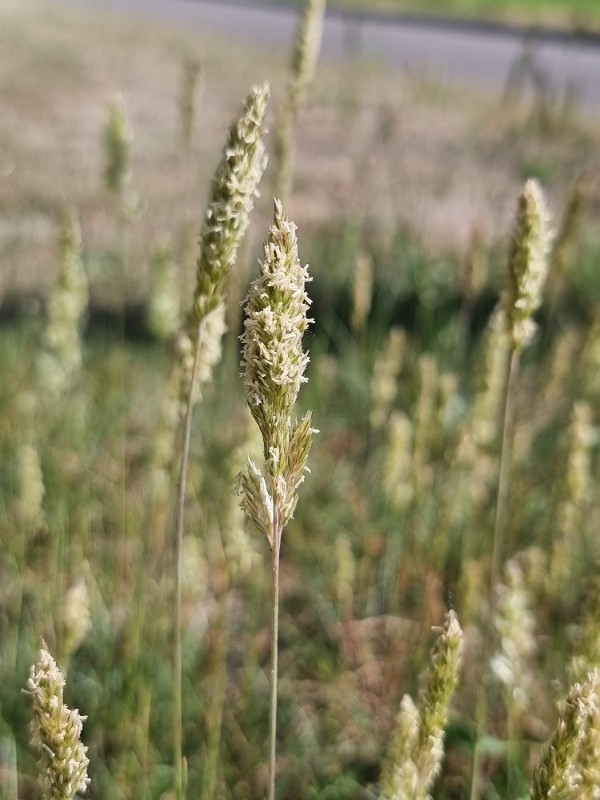
Koeleria, Genus, macrantha, Species,
- Genus & species
prairie junegrass
Overview
Koeleria macrantha is a cool-season perennial bunchgrass that forms dense tufts of narrow blue-green to gray-green leaves 4-8 inches (10-20 cm) long, with flowering stems rising to 12-24 inches (30-60 cm). In late spring it sends up a tight, spike-like flowering panicle 2-5 inches (5-13 cm) long that is silvery green and shimmers when it catches the light, narrowing and turning straw-colored as the seed ripens. The clump itself stays compact, usually 6-12 inches (15-30 cm) wide, and the basal foliage is semi-evergreen in mild climates, dying back in hard winters. K. macrantha grows from fibrous roots in well-drained soils and is widely distributed across the prairies and dry grasslands of North America, Europe, and Asia. It withstands drought, cold, and poor soils, but it is short-lived compared with warm-season prairie grasses and tends to thin out after a few years unless it self-sows. It also grows slowly to fill in, so a planting takes time to knit together. Its height of 1-2 feet (30-60 cm) places it at the front of grass and meadow plantings.
Native Range
Koeleria macrantha has a broad circumboreal native range, occurring across the grasslands and open woodlands of North America, Europe, and Asia. In North America it grows in dry prairies, sandy plains, and rocky slopes from Canada through the United States into Mexico.Suggested Uses
K. macrantha is used in prairie restorations, meadow plantings, rock gardens, and the front edges of mixed grass borders, and it serves as a cool-season component in native lawns and erosion plantings. Its seed feeds birds and the foliage shelters small wildlife. The compact clumps suit small-scale and naturalistic plantings.How to Identify
Appearance
Size & Dimensions
Height1' - 2'
Width/Spread6" - 1'
Bloom Information
K. macrantha flowers in late spring to early summer, typically May through June, giving the common name Junegrass. The silvery panicle opens briefly to release wind-borne pollen, then tightens as seed develops and fades to straw color. Seed ripens through midsummer and the dried heads persist into autumn.
Detailed Descriptions
Foliage Description
Blue-green to gray-greenGrowing Conditions
Sun Requirements
Requires 6-12 hours of direct sunlight daily
• Full Sun: 6+ hours of direct sunlight
• Partial Shade: 3-6 hours of direct sunlight
• Full Shade: Less than 3 hours of direct sunlight
Care & Maintenance
Care Guide
K. macrantha grows in full sun and well-drained sandy, loamy, or rocky soil with a pH from 6.0 to 8.0, and it withstands drought once established. As a cool-season grass it makes most of its growth in spring and fall and may brown during hot, dry midsummer spells. Plants need little water beyond establishment and no supplemental feeding in average soils. Dividing crowded clumps every few years keeps them vigorous and offsets the species short lifespan. It self-sows readily, which helps maintain a stand over time. Rust and leaf spot occur occasionally in humid or crowded conditions.Pruning
K. macrantha is cut back to a few inches above the crown in late winter before new spring growth, which removes the previous year dried foliage and seed heads. Shearing the spent flower stems in summer tidies the clump but removes the self-sown seed. Dividing every two to three years renews aging tufts.Container Growing
Suitable for container growing
Minimum container size: 2 gallons