Image 1 of 10
1 / 10
No machine-readable author provided. Casliber assumed (based on copyright claims)., no rights reserved (CC0) · Wikimedia Commons
Kennedia, Genus, prostrata, Species,
- Genus & species
running postman
Overview
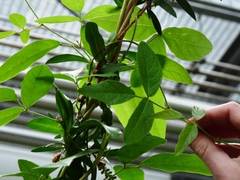
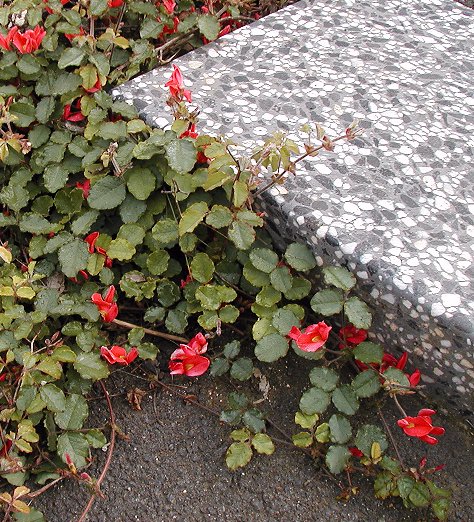
Kennedia prostrata is a prostrate, trailing perennial in the pea family (Fabaceae), forming a groundcover 2-4 inches (5-10 cm) high and spreading 3-6 feet (1-2 m) across. The leaves are divided into three rounded leaflets, each 0.4-1.2 inches (1-3 cm) long, with wavy, crinkled margins and a slightly rough surface. From late winter through spring it bears scarlet-red pea flowers about 0.5-0.8 inch (12-20 mm) long, each marked with a yellow or greenish spot at the centre, held singly or in small clusters on short stalks. Flat pods 1-2 inches (2.5-5 cm) long follow. It grows naturally across southern Australia, from Western Australia through South Australia, Victoria, New South Wales, and Tasmania, in open forest, heath, and coastal scrub, often on sandy or gravelly soils. The trailing stems root at the nodes where they contact moist ground, helping the plant cover bare slopes and stabilise loose soil. It tolerates drought, light frost, and coastal exposure once established. As a legume it fixes nitrogen through root nodules. Growth can be vigorous, and stems may scramble over low neighbouring plants. In heavy, poorly drained soil the plant is short-lived and prone to root rot.
Native Range
Kennedia prostrata is native to southern Australia, occurring across Western Australia, South Australia, Victoria, New South Wales, and Tasmania. It grows in open forest, heathland, and coastal scrub, usually on free-draining sandy or gravelly soils.Suggested Uses
Grown as a groundcover on banks, sandy slopes, and rockeries, and to bind loose or eroding soil. It suits native, coastal, and water-wise gardens, and trails from raised beds and large containers. The creeping stems fill space between shrubs.How to Identify
Appearance
Size & Dimensions
Height2" - 4"
Width/Spread3' - 6'
Bloom Information
Scarlet-red pea flowers appear from late winter into spring, roughly August to November in the native range. Flowering is concentrated over several weeks and is heaviest in full sun. Scattered blooms can appear at other times in mild climates.
Detailed Descriptions
Flower Description
scarlet-red with yellow centreFoliage Description
greenGrowing Conditions
Sun Requirements
Requires 5-9 hours of direct sunlight daily
• Full Sun: 6+ hours of direct sunlight
• Partial Shade: 3-6 hours of direct sunlight
• Full Shade: Less than 3 hours of direct sunlight
Care & Maintenance
Care Guide
Grow in full sun to light shade in free-draining sandy, gravelly, or loamy soil. Water through the first summer to establish, after which the plant tolerates extended dry periods. Heavy, wet soils cause root rot and shorten the plant life. As a phosphorus-sensitive legume, it needs only low-phosphorus native fertiliser, if any. Light frost is tolerated, though hard frost can damage exposed stems. Runners that spread beyond the intended area can be trimmed back.Pruning
Formal pruning is not required. Stems can be cut back after flowering to control spread or to renew the cover. The plant reshoots from the base and from trailing nodes, so it recovers from a hard trim in spring.Container Growing
Suitable for container growing