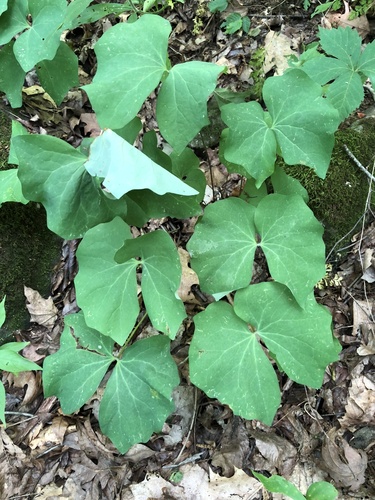
Jeffersonia, Genus, diphylla, Species,
- Genus & species
twinleaf
Eastern North America from southern Ontario and New York south through Pennsylvania, Ohio, and the Appalachians to Alabama and Georgia; rich deciduous woodlands on calcareous (limestone-derived) soils
Overview
Jeffersonia diphylla is a small clumping deciduous perennial in the family Berberidaceae growing 6–16 inches (15–40 cm) tall and 8–12 inches (20–30 cm) wide from a slow-growing rhizome. Leaves are the most recognizable character of the species: each leaf is deeply divided into two symmetrical mirror-image lobes 3–6 inches (7–15 cm) across that together form a butterfly-wing outline, with the division extending almost down to the petiole base so that the two lobes appear as a pair of joined leaflets rather than a single lobed blade — the specific epithet diphylla is Latin for two-leaved and refers to this twin-lobed leaf structure. The genus name Jeffersonia honors Thomas Jefferson, who was an amateur botanist in addition to his political career, and the species was named in his honor by Benjamin Smith Barton in 1793 shortly after Jefferson left the post of Secretary of State. The only other species in the genus is J. dubia from the mountains of Manchuria, Korea, and eastern Russia, which carries similar twin-lobed leaves and lavender flowers and is sometimes placed in the separate genus Plagiorhegma. White solitary flowers 1 inch (2.5 cm) across with 8 petals open one per leafless stalk above the emerging foliage in March and April, and each individual flower lasts only 1–2 days before the petals drop, making the twinleaf bloom among the briefest-lived of spring ephemeral wildflowers — the total bloom window from first-open to last-dropped is 10–14 days at the colony level even though no single flower persists more than 2 days. A pear-shaped 3-lobed seed capsule 0.5 inch (1.3 cm) long develops after pollination and opens at the top through a hinged lid to release the seeds in early summer. Limitation: the brief bloom window and the very slow establishment from seed are the main considerations — seedlings take 3–5 years to reach flowering size and mature clumps take 5–8 years to reach their full display of 10–20 leaves and flowering stems, which makes the species a patient long-term woodland garden subject rather than an immediate display planting. The species is not drought-tolerant and calls for consistently moist humus-rich woodland soil through the growing season, and it grows on calcareous (limestone-derived) substrates that match the soil chemistry of its native range in the eastern North American Appalachian and Ohio Valley woodlands.
Native Range
Native to eastern North America from southern Ontario and New York south through Pennsylvania, Ohio, West Virginia, and the Appalachian Mountains to Alabama and Georgia, and west through Indiana, Illinois, Kentucky, and Tennessee. Grows in rich deciduous woodlands, often on calcareous (limestone-derived) soils in the understory of sugar maple, American beech, white ash, and tulip poplar forests. The species has become locally rare across parts of its range because of habitat loss and over-collection by wildflower gardeners, and is listed as threatened or of conservation concern in several US states.Suggested Uses
Used in woodland gardens, native wildflower plantings, shaded rock gardens on calcareous soils, and mixed spring ephemeral plantings with Sanguinaria canadensis, Hepatica americana, Dicentra cucullaria, and Trillium grandiflorum at 8–12 inch (20–30 cm) spacing. The twin-lobed butterfly-wing foliage carries the species through the full growing season as a foliage plant even after the brief spring bloom has passed, and the pear-shaped hinged seed capsule supplies a second seasonal feature in late spring and early summer. Dry sunny positions, heavy clay soils without drainage amendment, and gardens where immediate visual impact is the design goal are unsuitable because of the high moisture requirement, the preference for calcareous substrates, and the very slow establishment rate of the species.How to Identify
Appearance
Size & Dimensions
Height6" - 1'4"
Width/Spread8" - 1'
Bloom Information
White solitary 8-petaled flowers 1 inch (2.5 cm) across open one per leafless stalk above the emerging foliage in March and April across a 2-week colony-level bloom window, although each individual flower lasts only 1–2 days before the petals drop, making the twinleaf bloom among the briefest-lived of spring ephemeral wildflowers. Honeybees and native bees work the flowers for nectar during the short open period. A pear-shaped 3-lobed seed capsule 0.5 inch (1.3 cm) long develops after pollination through April and May, and opens at the top through a hinged lid to release the seeds in June, which is a structure shared with no other eastern North American spring wildflower.
Detailed Descriptions
Flower Description
white solitary flowers 1 inch (2.5 cm) across with 8 petals, carried one per leafless stalk above the emerging foliage; each flower lasts only 1-2 days before the petals drop, and the total bloom window is compressedFoliage Description
mid-green through the growing season; leaves are deeply divided into two symmetrical mirror-image lobes 3-6 inches (7-15 cm) across that together form a butterfly-wing outline, with the division extending almost to the petiole base; turns yellow in fall before leaf dropGrowing Conditions
Sun Requirements
Requires 1-4 hours of direct sunlight daily
• Full Sun: 6+ hours of direct sunlight
• Partial Shade: 3-6 hours of direct sunlight
• Full Shade: Less than 3 hours of direct sunlight
Care & Maintenance
Care Guide
Site in part shade to full shade with 1–4 hours of direct sun per day, typically under the deciduous canopy of sugar maple, American beech, or white ash where the spring light period supports bloom and leaf expansion and the summer shade holds soil moisture during the warm months. Soil should be consistently moist, humus-rich, and well-drained with a pH of 6.0–7.5, and the species is found on calcareous (limestone-derived) substrates that match the soil chemistry of its native Appalachian and Ohio Valley woodlands. The species is not drought-tolerant and declines during extended summer dry periods on positions without supplemental irrigation or naturally moist soils. Established clumps are not divided or disturbed because the slow-growing rhizome re-establishes poorly after disturbance and the plant takes 3–5 years to recover from a transplant. Self-sown seedlings around the parent plant are the main propagation method, and the seedlings take an additional 3–5 years to reach flowering size. Toxicity is not well documented. Hardy in USDA zones 4–8.Pruning
Dead foliage is cleared in late fall (October or November) after the leaves have yellowed and collapsed to the ground, and the cleared material is removed to the compost pile or left as leaf litter mulch over the dormant crown for winter protection. No other pruning is needed. Established clumps are not divided because the slow-growing rhizome re-establishes poorly after disturbance and the plant takes 3–5 years to recover from a transplant, so propagation is through self-sown seedlings rather than division of mature crowns.Pruning Schedule
Prune: October–November
fall