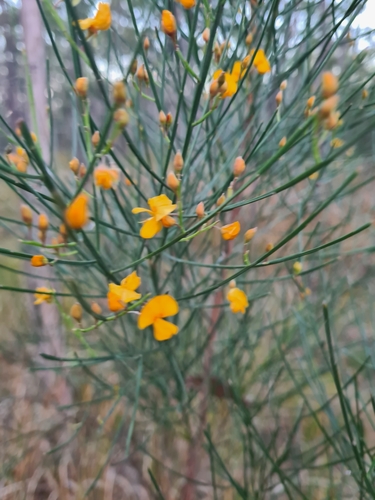
Jacksonia, Genus, spp., Multiple species,
- Genus
- Multiple species
Australia (centred on southwest Western Australia)
Overview
Jacksonia is a genus of about fifty species of shrubs and small trees in the pea family, Fabaceae, endemic to Australia. Many species are leafless or nearly so as adults, carrying out photosynthesis in flattened, winged, or rush-like green stems, and a number are stiff and spiny. Plants range across the genus from low shrubs to small trees roughly 2 to 13 feet (0.6 to 4 m) tall. From spring into summer they carry small pea flowers in yellow, orange, and reddish tones, often with darker markings, borne singly or in short spikes along the stems and sometimes lightly scented. Like other legumes, Jacksonia fixes nitrogen through root nodules, which lets it grow on the nutrient-poor sandy soils of its native heath and woodland. The genus is centred on the southwest of Western Australia, with further species in eastern and northern Australia. Most species are frost-tender and short-lived in cultivation, and the leafless spiny habit gives a sparse, twiggy look that suits some gardens more than others.
Native Range
Jacksonia is endemic to Australia, with the greatest number of species in the southwest of Western Australia and others in eastern and northern Australia. The shrubs grow in heath, scrub, and open woodland on sandy, nutrient-poor soils.Suggested Uses
Jacksonia is used in native, water-wise, and habitat gardens in mild dry climates, and in revegetation of sandy heath and disturbed bushland. The flowers add spring colour and support native pollinators, and the spiny species provide shelter for small birds. The wiry leafless forms suit naturalistic and low-water plantings.How to Identify
Appearance
Size & Dimensions
Height2' - 13'
Width/Spread2' - 10'
Bloom Information
Flowering occurs mainly in spring and early summer, roughly September to December in the native range. The small pea flowers are yellow to orange and red, often marked with darker tones, and some are lightly scented. Native bees and other insects visit the flowers for pollen and nectar.
Detailed Descriptions
Flower Description
yellow, orange, and redFoliage Description
greenGrowing Conditions
Sun Requirements
Requires 6-10 hours of direct sunlight daily
• Full Sun: 6+ hours of direct sunlight
• Partial Shade: 3-6 hours of direct sunlight
• Full Shade: Less than 3 hours of direct sunlight
Care & Maintenance
Care Guide
Jacksonia grows in full sun in sandy, gravelly, sharply drained soils that are low in nutrients, reflecting its heath origins. As a nitrogen-fixing legume it needs no added fertiliser and is sensitive to phosphorus, which can damage the roots. Most species are frost-tender, suited to roughly USDA zones 9 to 10 and dry Mediterranean-type climates. Plants are drought-tolerant once established and cope with dry, exposed sites, while they are short-lived on wet or heavy soils. Propagation is by seed, which germinates more readily after heat or smoke treatment that mimics fire, or by cuttings of firm young growth.Pruning
A light trim after flowering keeps the shrubs dense and shapely. Cutting into old bare stems is left undone, as the plants reshoot slowly from hard wood. Removing dead or damaged stems can be done at any time.Container Growing
Suitable for container growing
Minimum container size: 5 gallons
