Isatis, Genus, tinctoria, Species,
- Genus & species
woad
Southeastern Europe and western and central Asia
Overview
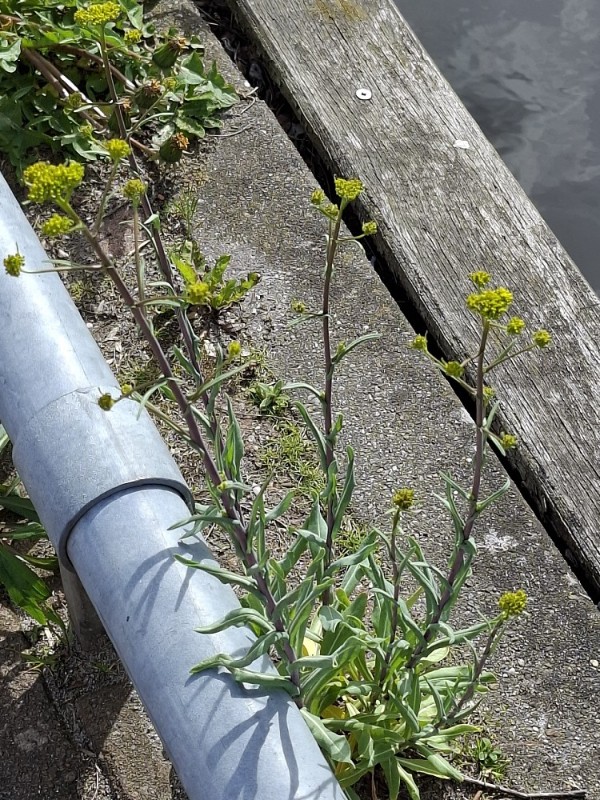
Isatis tinctoria is a biennial or short-lived perennial in the cabbage family, grown historically as the source of a blue dye. In its first year it forms a basal rosette of blue-green, lance-shaped leaves 4-8 inches (10-20 cm) long. In the second year it sends up a branched flowering stem 24-48 inches (60-120 cm) tall carrying open panicles of small four-petalled yellow flowers from late spring into summer. The flowers are followed by pendulous, flattened seed pods 0.5-0.75 inch (1.3-2 cm) long that ripen from green to purplish-black. A single plant can produce hundreds of seeds and self-sows freely. It is listed as a noxious weed in several western United States, where it spreads on rangeland and roadsides. After flowering and setting seed the plant dies.
Native Range
Native to southeastern Europe and western and central Asia, and naturalized across much of Europe and North America. Grows on disturbed ground, roadsides, rocky slopes, and field margins in full sun on well-drained soils. Listed as a noxious weed in parts of the western United States.Suggested Uses
Grown in dye gardens, dry borders, and herb plantings at 10-12 inch (25-30 cm) spacing. Leaves are used to make a blue dye. Heavy self-seeding and weed status make it difficult to contain and unsuited to plantings near rangeland.How to Identify
Appearance
Size & Dimensions
Height2' - 4'
Width/Spread1' - 1'6"
Colors
Bloom Information
Detailed Descriptions
Foliage Description
Blue-greenGrowing Conditions
Sun Requirements
Requires 6-12 hours of direct sunlight daily
• Full Sun: 6+ hours of direct sunlight
• Partial Shade: 3-6 hours of direct sunlight
• Full Shade: Less than 3 hours of direct sunlight
Care & Maintenance
Care Guide
Grows in full sun in well-drained soil and tolerates poor, dry, and rocky ground. Performs poorly in wet or shaded sites. Water during establishment of the first-year rosette in dry spells; mature plants tolerate drought. Self-sows prolifically, producing many seedlings that spread well beyond the planting. Flea beetles and other cabbage-family pests feed on the foliage. The plant dies after flowering, leaving gaps that fill with seedlings.Pruning
Cut flowering stems before the seed pods ripen to prevent self-seeding and spread. Remove the whole plant after it sets seed and dies. No other pruning is needed.Pruning Schedule
Prune: June–July
summer
Toxicity
Non-toxicPlanting Guide
Planting Methods & Timing
Planting Method
direct sow
Direct Sow Timing
Sow in spring or late summer where plants are to grow; the rosette forms in the first year and flowers the next.
Plant Spacing
12 inches