Image 1 of 9
1 / 9
© שנילי - שיחה . Original uploader was שנילי at he.wikipedia, some rights reserved (CC-BY-SA) · Wikimedia Commons
Ipomoea, Genus, batatas, Species,
- Genus & species
Sweet potato
Overview
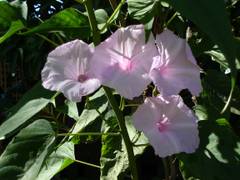
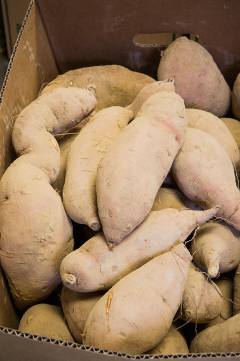
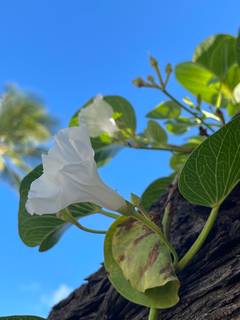
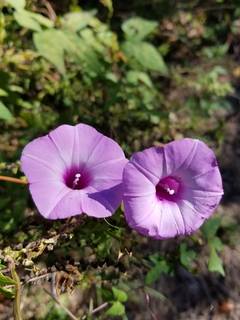
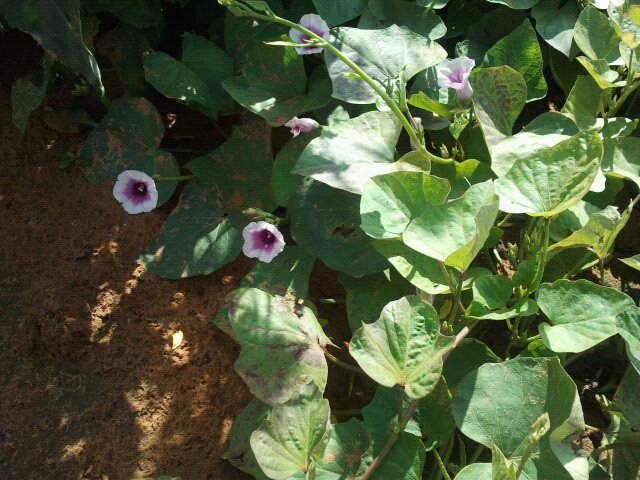
Ipomoea batatas is a frost-tender perennial vine in the morning glory family grown as an annual for its swollen storage roots. Trailing stems run 3-16 feet (0.9-5 m) across the ground and root at the nodes, holding the leaf canopy 6-12 inches (15-30 cm) above soil level. Leaves are alternate, 2-6 inches (5-15 cm) long, and differ within the species from entire and heart-shaped to deeply three or five-lobed, in green, bronze, purple or chartreuse according to cultivar. Storage roots begin forming 40-60 days after planting and reach 4-10 inches (10-25 cm) long, with skin in white, yellow, orange, red or purple and flesh from cream through deep orange to purple. Funnel-shaped flowers 1.5-2 inches (4-5 cm) across, pale lavender with a dark throat, appear irregularly and set little or no seed in temperate summers. Propagation is from slips, rooted shoots pulled from a sprouted storage root, because seed does not come true. Roots call for 90-120 frost-free days above 65F (18C) and stop enlarging below that, and harvested roots are injured by storage under 55F (13C). Sweet potato weevil and wireworm tunnel the roots across warm regions.
Native Range
Ipomoea batatas was domesticated in tropical Central or South America, with the closest wild relative Ipomoea trifida ranging from Mexico to Venezuela; root remains from coastal Peru date to roughly 8,000 years before present. The crop reached Polynesia ahead of European contact, a dispersal traced through linguistic and genetic evidence across the Pacific. It is now grown throughout the tropics and through temperate summers from the southern United States to eastern China.Suggested Uses
Grown in vegetable beds, raised beds and ridged rows 8-10 inches (20-25 cm) high that give the roots loose depth, at 12-18 inch (30-45 cm) spacing. Chartreuse, bronze and near-black foliage cultivars are used in containers, window boxes and hanging baskets as trailing summer foliage, with stems reaching 3-5 feet (0.9-1.5 m) in a season. The dense canopy is used as living mulch between widely spaced tall vegetables.How to Identify
Appearance
Size & Dimensions
Height6" - 1'
Width/Spread3' - 16'
Bloom Information
Flowering is irregular in temperate cultivation and many crops finish a season without blooming at all. Where flowers do appear they open between July and September, singly or in small cymes at the leaf axils, each lasting a single morning. Short days and warm nights bring on bloom, so flowering is routine in tropical latitudes and sparse above 35 degrees of latitude. Seed set in temperate gardens is uncommon and the crop is not raised from seed.
Detailed Descriptions
Flower Description
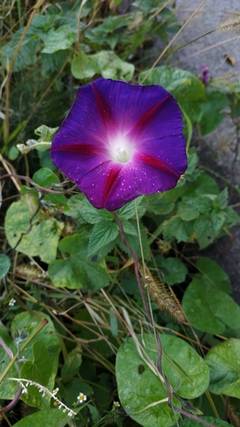
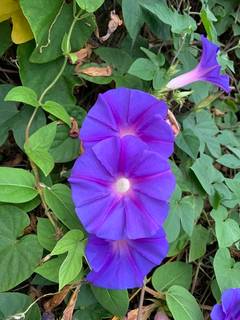
pale lavender with a purple throatFoliage Description
green, bronze, purple or chartreuse by cultivarGrowing Conditions
Sun Requirements
Requires 6-10 hours of direct sunlight daily
• Full Sun: 6+ hours of direct sunlight
• Partial Shade: 3-6 hours of direct sunlight
• Full Shade: Less than 3 hours of direct sunlight
Water & Climate
Water Needs
Drought Tolerance
Drought tolerant when established
Care & Maintenance
Care Guide
Grows in full sun with 6-8 hours of direct light in loose free-draining sandy loam at pH 5.5-6.5, where roots expand without meeting compaction. Slips are planted 12-18 inches (30-45 cm) apart in rows 3-4 feet (90-120 cm) apart, set deep enough to bury 3-4 nodes, once soil holds 65F (18C). Water use runs 1 inch (25 mm) per week through the first 6 weeks and then tapers, since heavy watering close to harvest splits the roots. Nitrogen stays near 0.25 lb per 100 sq ft (0.12 kg per 9 sq m) with potassium raised, as high nitrogen builds vine growth ahead of root bulking. Roots are lifted before soil falls below 55F (13C), cured at 80-85F (27-29C) and 85 percent humidity for 5-10 days, then held at 55-60F (13-16C). Deer and voles graze the vines and roots, and root-knot nematode deforms roots in sandy ground.Pruning
No pruning is carried out where storage roots are the crop, since the vines feed root bulking and their removal cuts yield. Runners straying past the bed edge are lifted and turned back rather than cut, so the nodes do not root and form small secondary tubers. Cultivars grown for foliage in containers are cut back by a third once stems pass 3 feet (90 cm), and regrow within 2-3 weeks.Container Growing
Suitable for container growing
Minimum container size: 5 gallons