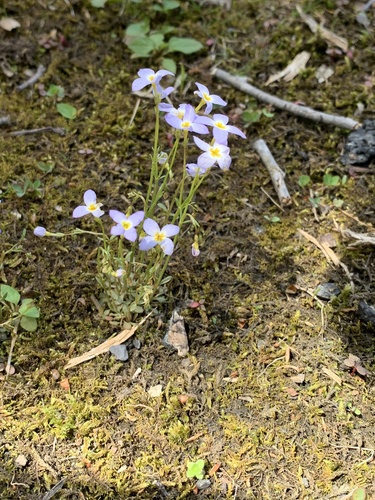
Houstonia, Genus, caerulea, Species,
- Genus & species
azure bluet
Overview
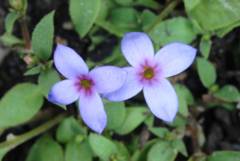
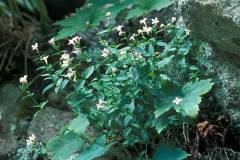
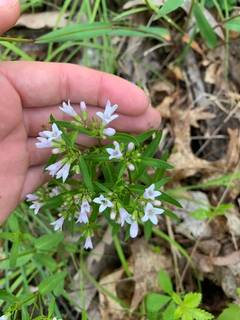
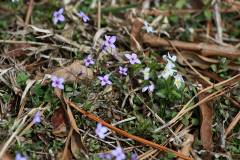
Houstonia caerulea is a small, tufted perennial in the madder family, forming low rosettes 2-8 inches (5-20 cm) tall from which slender, thread-like flowering stems rise. The basal leaves are tiny, spoon-shaped, and 0.2-0.6 inch (5-15 mm) long, while the stem leaves are smaller and paired. Each stem carries a single upturned flower about 0.4 inch (1 cm) across, with four pale blue to nearly white petals fused into a short tube and a yellow center. Flowering is heaviest in spring, from April to June, with scattered blooms into summer. Plants grow in tufts in moist, acidic, sandy or rocky soil in open woods, meadows, lawns, and stream banks. They spread slowly by short rhizomes and by seed to form loose colonies. The plant is short-lived but self-sows where conditions suit it. It is easily lost in dense turf or dry soil. Small bees and flies visit the flowers for nectar.
Native Range
Houstonia caerulea is native to eastern North America, from Ontario and Quebec south through the eastern United States to Georgia and Alabama. It grows in moist, acidic soils of open woods, meadows, grassy slopes, lawns, and streambanks.Suggested Uses
Grown in rock gardens, woodland edges, and naturalized lawns, where it forms drifts of pale blue spring flowers. It grows in moist, acidic sites where few other small perennials thrive. Small native bees use the flowers for nectar.How to Identify
Appearance
Size & Dimensions
Height2" - 8"
Width/Spread3" - 6"
Bloom Information
Pale blue, yellow-eyed flowers open from April through June, peaking in mid-spring. Scattered flowers may appear into summer in cool, moist sites. Each slender stem holds a single bloom.
Detailed Descriptions
Flower Description
pale blue with yellow eyeFoliage Description
greenGrowing Conditions
Sun Requirements
Requires 4-8 hours of direct sunlight daily
• Full Sun: 6+ hours of direct sunlight
• Partial Shade: 3-6 hours of direct sunlight
• Full Shade: Less than 3 hours of direct sunlight
Care & Maintenance
Care Guide
Plants grow in part shade to full sun in moist, acidic, well-drained sandy or rocky soil. They need steady moisture in spring and tend to fade in hot, dry conditions. The species is short-lived but self-seeds to maintain a colony where competition is light. It can grow in thin lawns that are not heavily fertilized or mown too short. Established tufts can be divided in spring. Hardy in USDA zones 3 to 8.Pruning
No pruning is needed for this small perennial. Mowing can be delayed until after flowering and seed set to let colonies persist in lawns. Spent stems wither on their own.Container Growing
Suitable for container growing
Minimum container size: 1 gallons