Honckenya, Genus, peploides, Species,
- Genus & species
sea sandwort
Circumboreal coasts of Europe, Asia, and North America
Overview
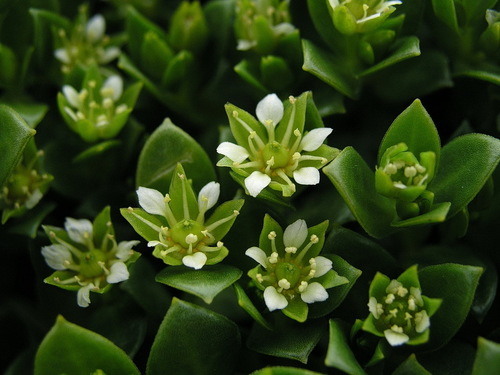
Honckenya peploides is a low, mat-forming perennial of the pink family, spreading by creeping rhizomes to form patches 10-25 cm (4-10 in) tall over sand and shingle. The fleshy, succulent leaves are 1-2.5 cm (0.4-1 in) long, oval to lance-shaped, yellow-green, and packed in opposite pairs along sprawling, four-angled stems. The plant is largely dioecious, with greenish-white five-petalled flowers 6-10 mm (0.24-0.4 in) across borne in the leaf axils from late spring; male flowers have larger petals than the female ones. Rounded, pea-like capsules follow, holding a few large seeds that can float in seawater. It grows on coastal foredunes, sandy and shingle beaches, and drift lines, where it helps stabilise loose sand. The species tolerates salt spray, burial by blowing sand, and drought but needs open, sunny coastal ground and fails inland or in shade. Its succulent, ground-hugging mats stay low and carry small, easily missed flowers.
Native Range
Honckenya peploides has a circumboreal distribution along the coasts of Europe, northern Asia, and North America, reaching into the Arctic. In North America it grows on both Atlantic and Pacific shores and around the far north. It is confined to sandy and shingle coasts within this range.Suggested Uses
Honckenya peploides is used in coastal and dune-restoration plantings and seaside gravel gardens where salt and blowing sand exclude most plants. It binds loose sand on foredunes and drift lines. The fleshy young shoots are edible and have a history of coastal foraging use.How to Identify
Appearance
Size & Dimensions
Height4" - 10"
Width/Spread1' - 2'
Bloom Information
Greenish-white flowers open from May to August in the leaf axils, small and easy to overlook. Insects visit the flowers, which differ between male and female plants. Rounded capsules ripen through summer, releasing buoyant seeds that drift to new shores.
Detailed Descriptions
Foliage Description
yellow-greenGrowing Conditions
Sun Requirements
Requires 6-12 hours of direct sunlight daily
• Full Sun: 6+ hours of direct sunlight
• Partial Shade: 3-6 hours of direct sunlight
• Full Shade: Less than 3 hours of direct sunlight