Honckenya, Genus, spp., Multiple species,
- Genus
- Multiple species
Arctic and cool-temperate coasts of the northern hemisphere
Overview
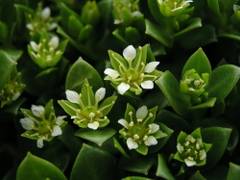
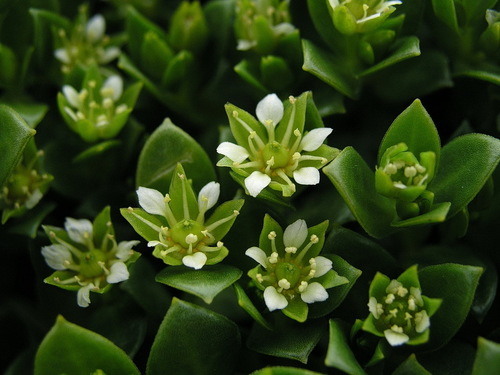
Honckenya is a genus of the pink family, Caryophyllaceae, represented by the single widespread species H. peploides, sea sandwort, which circles the cool-temperate and arctic coasts of the northern hemisphere. It is a low, mat-forming perennial 2-10 inches (5-25 cm) tall that spreads by deep, brittle rhizomes to form patches several feet across on sand and shingle beaches. The stems are fleshy and densely set with opposite, succulent, yellow-green leaves 0.4-1 inch (1-2.5 cm) long that overlap along the shoots. From late spring into summer, small five-petalled flowers about 0.3 inch (8 mm) wide open in the leaf axils, greenish-white and easily overlooked; plants are functionally male or female, so seed forms only where both occur. The rounded, pea-like capsules hold a few large seeds that float and disperse on tidewater. As a pioneer of mobile sand, the species binds shifting dunes and tolerates salt spray, burial, and wind. Its tolerances are narrow and maritime: it does poorly in heat, on inland soils, and in shade, and is rarely grown away from the coast.
Native Range
Native to sand and shingle shores around the cool-temperate and arctic northern hemisphere, including northern Europe, Iceland, Greenland, northern Asia, and northern North America on both the Atlantic and Pacific coasts.Suggested Uses
Grown in coastal and dune restoration, seaside gardens, and gravel plantings within reach of salt air. It binds loose sand and stabilises the front of dunes. It is occasionally gathered as an edible green in parts of the North Atlantic.How to Identify
Appearance
Size & Dimensions
Height2" - 10"
Width/Spread1' - 3'
Colors
Bloom Information
Flowering runs from late spring through midsummer, roughly May to July, varying with latitude. The small greenish-white flowers open in the leaf axils and are inconspicuous against the foliage. Capsules ripen later in summer and release floating seeds.
Detailed Descriptions
Foliage Description
Yellow-greenGrowing Conditions
Sun Requirements
Requires 6-12 hours of direct sunlight daily
• Full Sun: 6+ hours of direct sunlight
• Partial Shade: 3-6 hours of direct sunlight
• Full Shade: Less than 3 hours of direct sunlight