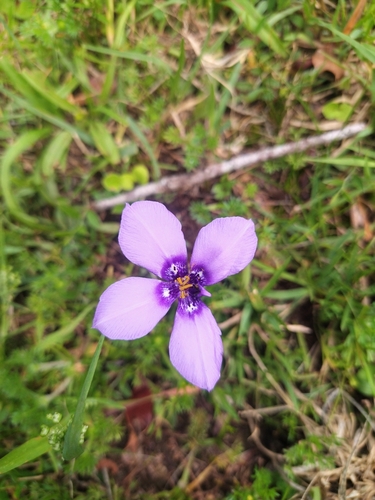
Herbertia, Genus, lahue, Species,
- Genus & species
prairie nymph
Southern United States and South America
Overview
Herbertia lahue is a small bulbous perennial in the iris family, growing 6-12 inches (15-30 cm) tall from an underground corm. It produces a few narrow, pleated, grass-like leaves in late winter and spring. Each flower is about 1-1.5 inches (2.5-4 cm) across, with three broad violet-blue outer petals marked with white and purple toward the center and three much smaller inner segments. Flowers open in the morning and close by afternoon, lasting a single day, while a clump produces a succession of blooms over several weeks in spring. After flowering, the plant sets capsules and goes dormant through the heat of summer, the foliage dying back to the corm. It grows in coastal prairies, moist meadows, roadside swales, and open grassy ground, and naturalizes in lawns where mowing is delayed until after bloom. The species spreads slowly by offset corms and by seed, forming loose colonies. Its brief daily flowers and summer dormancy mean the display is short and the plant is absent above ground for much of the year. Found in the southern United States and parts of South America, it is hardy in USDA zones 7 to 9.
Native Range
Native to the Gulf Coast and south-central United States, including Texas, Louisiana, and adjacent states, with a separate range in temperate South America, growing in coastal prairies, moist grasslands, and seasonally damp meadows.Suggested Uses
Used in native plantings, prairie restorations, rock gardens, and unmown or lightly mown lawn areas, spaced 4-6 inches (10-15 cm) apart in groups. Suits naturalized spring meadows and the front of borders where its summer dormancy is masked by later plants. Grows in containers that can be kept dry in summer.How to Identify
Appearance
Size & Dimensions
Height6" - 1'
Width/Spread4" - 6"
Bloom Information
Blooms in spring, mainly March to May, with each flower opening in the morning and closing by early afternoon. A clump opens new flowers over three to five weeks. Bloom timing follows soil warmth and spring moisture, ending as the plant enters summer dormancy.
Detailed Descriptions
Foliage Description
greenGrowing Conditions
Sun Requirements
Requires 5-8 hours of direct sunlight daily
• Full Sun: 6+ hours of direct sunlight
• Partial Shade: 3-6 hours of direct sunlight
• Full Shade: Less than 3 hours of direct sunlight
Care & Maintenance
Care Guide
Grow in full sun to part shade in moist, well-drained soil that stays damp in spring; it tolerates seasonal wetness during growth. After flowering the corm needs a drier summer rest, so heavy summer irrigation can rot it. In lawns, mowing is held off until the foliage yellows so the corm can recharge. It is hardy in zones 7 to 9 and increases slowly by offsets and self-sown seed. Congested clumps can be lifted and divided during summer dormancy. No serious pests or diseases affect it.Pruning
No pruning is needed beyond letting the foliage die back naturally after bloom. Spent flower stalks can be removed, though leaving some allows self-seeding. Clear dead leaves once they have fully yellowed.Container Growing
Suitable for container growing
Minimum container size: 1 gallons