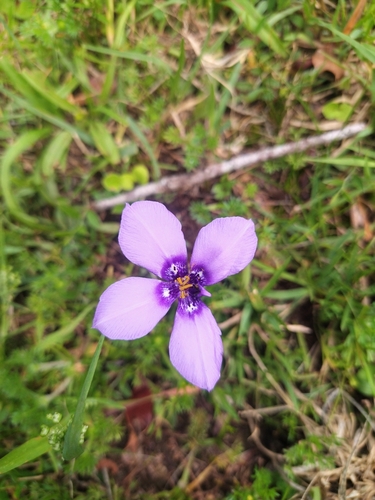
Herbertia, Genus, spp., Multiple species,
- Genus
- Multiple species
prairie nymph
South America and the southern United States
Overview
Herbertia is a genus of about six to eight small bulbous plants in the iris family, Iridaceae, native to temperate South America and the southern United States. Each corm produces a few narrow, pleated leaves and short stems 4-12 inches (10-30 cm) tall in spring. The flowers have three broad, spreading outer tepals in shades of lilac, violet, or blue, usually with a paler or white, often spotted center, and three much smaller inner tepals. Individual flowers last only a day, but a succession opens over several weeks. The North American H. lahue, called prairie nymph, grows in damp grassland and prairie along the Gulf Coast. After flowering the foliage dies back and the corms rest through summer. Because each bloom is so brief, the plants are easy to overlook except on sunny mornings when the flowers are open.
Native Range
Native to temperate South America, including Argentina, Uruguay, southern Brazil, and Chile, with H. lahue extending to the Gulf Coast of the southern United States. Plants grow in seasonally moist grassland, prairie, and open damp ground.Suggested Uses
Used in rock gardens, bulb frames, and seasonally moist meadow plantings, set 3-6 inches (8-15 cm) apart in groups. The spring flowers draw early bees on sunny mornings. Container culture suits the brief, low-growing display where it can be viewed closely.How to Identify
Appearance
Size & Dimensions
Height4" - 1'
Width/Spread4" - 8"
Bloom Information
Flowering occurs in spring, generally March to May depending on climate. Each flower lasts a single day, opening in morning sun, but new buds continue over several weeks. Bloom is heaviest after a moist winter and cool spring.
Detailed Descriptions
Flower Description
lilac to violet-blue with a paler centerFoliage Description
greenGrowing Conditions
Sun Requirements
Requires 6-12 hours of direct sunlight daily
• Full Sun: 6+ hours of direct sunlight
• Partial Shade: 3-6 hours of direct sunlight
• Full Shade: Less than 3 hours of direct sunlight
Care & Maintenance
Care Guide
Plants grow in full sun and well-drained soil that stays moist through the spring growing season. The corms are watered during growth and flowering, then kept drier as the foliage dies back into summer dormancy. Hardy forms such as H. lahue tolerate light frost, roughly to USDA zone 7, while South American species are more tender. Heavy, wet soil in the dormant season can rot the corms. Plants increase by offset corms and by self-sown seed where conditions suit. Crowded clumps are lifted and divided during dormancy.Pruning
No pruning is needed beyond removing spent flower stems if seed is not wanted. The dying foliage is left in place to replenish the corm before it withers. Seed heads can be left to ripen for self-sowing.Container Growing
Suitable for container growing
Minimum container size: 1 gallons
