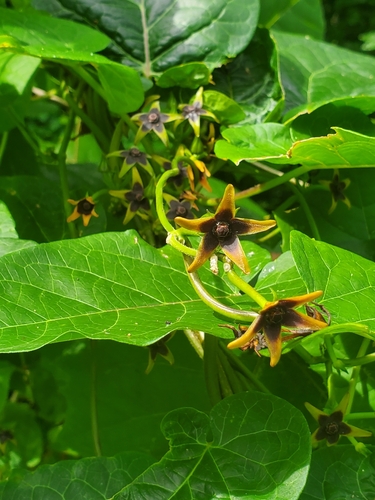
Gonolobus, Genus, suberosus, Species,
- Genus & species
anglepod
Overview
Gonolobus suberosus is a twining herbaceous vine in the milkweed subfamily of the Apocynaceae, climbing 10-16 ft (3-5 m) by season's end before dying back to the root in winter. Stems are slender and exude milky latex when cut. Leaves are opposite, heart-shaped, and 3-6 in (8-15 cm) long, with a pointed tip and a deep basal sinus. Small five-lobed flowers, each 0.4-0.6 in (10-15 mm) across, open greenish-yellow to pale tan in loose axillary clusters from late spring into summer. Pollinated flowers develop into a ridged, spindle-shaped follicle 3-5 in (8-12 cm) long that splits along one seam to release flat seeds tipped with silky white hairs. The vine spreads by seed and by a perennial rootstock, and stems can root where they contact moist soil. Growth is rapid once temperatures warm, which can crowd lower-growing neighbors on a trellis or fence. It occurs in bottomland woods, thickets, and stream margins across the southeastern United States. Foliage and fruit resemble several related milkvines, and the genus is sometimes treated under Matelea, so field identity rests on flower and follicle structure.
Native Range
Gonolobus suberosus is native to the southeastern United States, from Maryland and the Ohio Valley south to Florida and west to Texas. It grows in moist bottomland forests, riverbanks, thickets, and fence rows, usually in partial shade with steady soil moisture.Suggested Uses
Used on trellises, arbors, and fences in native plant and woodland gardens, where the twining stems climb available support. It suits naturalized plantings along stream banks and pond margins with reliable moisture. The milkweed-family flowers draw small bees and other insects.How to Identify
Appearance
Size & Dimensions
Height10' - 16'
Width/Spread3' - 6'
Bloom Information
Flowering runs from late spring through midsummer, roughly May to July across most of its range. The small clustered flowers are followed by elongated follicles that ripen in late summer and fall. Bloom is easy to overlook because the flower color blends with the surrounding foliage.
Detailed Descriptions
Flower Description
greenish-yellow to pale tanFoliage Description
greenGrowing Conditions
Sun Requirements
Requires 2-6 hours of direct sunlight daily
• Full Sun: 6+ hours of direct sunlight
• Partial Shade: 3-6 hours of direct sunlight
• Full Shade: Less than 3 hours of direct sunlight
Care & Maintenance
Care Guide
It grows in partial shade to filtered sun in soil kept consistently moist, matching its native streamside habitat. It adapts to loam, clay, and sandy soils with a near-neutral pH and tolerates brief flooding but not prolonged drought. A trellis, fence, or shrub supports the twining stems, which have no clinging tendrils or adhesive pads. Top growth dies back after frost and resprouts from the rootstock in spring. Pests and diseases are seldom limiting, though aphids may gather on new shoots. Established plants need little supplemental feeding in average soils.Pruning
Cut back dead top growth in late winter before new shoots emerge from the rootstock. Stems can be trimmed during the growing season to keep the vine within its support. No structural pruning is required.Pruning Schedule
Prune: February–March
winterearly spring