Gonolobus, Genus, spp., Multiple species,
- Genus
- Multiple species
milkweed vine
Overview
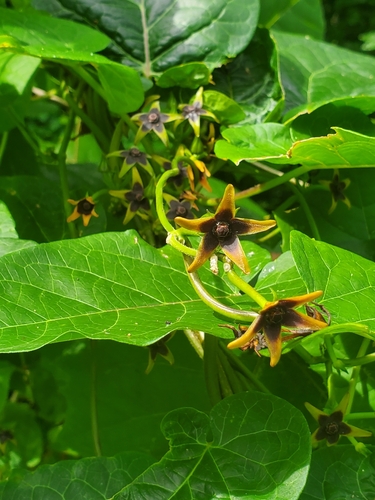
Gonolobus is a genus of roughly 100 to 150 species of twining, herbaceous to slightly woody vines in the milkweed subfamily of Apocynaceae, native to the warmer parts of the Americas from the southern United States through Mexico, Central America, and South America. The slender stems climb 6–20 ft (1.8–6 m) by twining and exude milky latex when broken. Paired, heart-shaped leaves 2–6 in (5–15 cm) long are carried opposite along the stems on long stalks. The wheel- or star-shaped flowers, 0.4–1.2 in (10–30 mm) across, have five spreading lobes in shades of green, yellow-green, maroon, or brown, often with a fleshy central corona, and are pollinated chiefly by flies and beetles drawn to their faint scent. Fertilised flowers form large, ribbed or warty paired follicles 3–6 in (8–15 cm) long that split to release flat seeds tipped with silky white hairs. The genus is a larval host for milkweed butterflies, and the milky sap contains compounds that can irritate skin. In parts of Mexico and Central America the unripe pods of some species are cooked and eaten. Plants grow quickly in a single warm season and can scramble densely over supporting vegetation.
Native Range
Native to the tropical and subtropical Americas, from the southern United States and Mexico through Central America to South America and the Caribbean. Plants grow in thickets, forest edges, and disturbed ground, climbing over shrubs and fences.Suggested Uses
Grown on trellises, arbours, and fences in warm-climate and butterfly gardens, where it supplies cover and a larval food source for milkweed butterflies. The fast growth also screens fences and outbuildings through summer.How to Identify
Appearance
Size & Dimensions
Height6' - 20'
Width/Spread3' - 6'
Bloom Information
Flowering occurs through the warm months, mainly summer into autumn in temperate areas and over a longer period in the tropics. The dull green to maroon flowers are carried in small stalked clusters from the leaf axils. Seed pods enlarge through late summer and autumn and persist after the leaves fall.
Detailed Descriptions
Flower Description
Green, yellow-green, maroon, or brownFoliage Description
GreenGrowing Conditions
Sun Requirements
Requires 4-10 hours of direct sunlight daily
• Full Sun: 6+ hours of direct sunlight
• Partial Shade: 3-6 hours of direct sunlight
• Full Shade: Less than 3 hours of direct sunlight
Care & Maintenance
Care Guide
Plants grow in full sun to part shade and in moist, free-draining soils with steady warmth, climbing readily on trellis, wire, or neighbouring shrubs. Moderate, regular water suits them through the growing season, with reduced moisture in winter where they die back. Most species are frost-tender and are grown as warm-season vines or under protection in cooler climates. They establish quickly from seed sown in spring and can self-sow where conditions suit. The milky sap may irritate skin and eyes on contact. Vigorous growth can overwhelm small supports, so a sturdy structure is useful.Pruning
Stems can be cut back hard in late winter or early spring before new growth, as plants flower on the current season shoots. Thinning crowded stems during the growing season keeps the vine open and within its support.Pruning Schedule
winterearly spring
