Glaucium, Genus, flavum, Species,
- Genus & species
yellow horned poppy
Coasts of Europe, the Mediterranean, North Africa, and western Asia
Overview
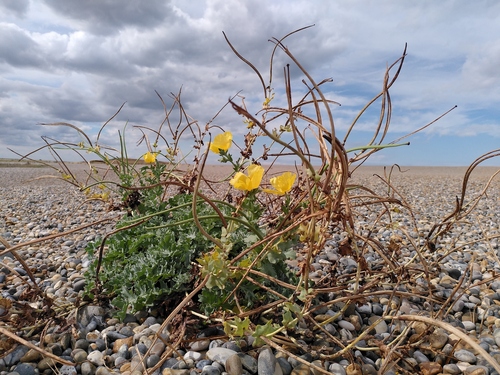
Glaucium flavum is a biennial or short-lived perennial 12-36 inches (30-90 cm) tall, with a basal rosette and branched stems covered in a blue-grey, glaucous bloom. The thick leaves are deeply lobed and roughly hairy, the lower ones stalked and the upper ones clasping the stem. Solitary yellow flowers 2-3.5 inches (5-9 cm) across open from June to September, each with four broad, papery, overlapping petals around a cluster of stamens. The flowers are followed by slender, curved seed pods 6-12 inches (15-30 cm) long that give the plant its horned name and split lengthwise to release many seeds. All parts contain glaucine and related alkaloids and exude a yellow latex when cut, and the plant is toxic if eaten. It grows on coastal shingle, sand, and cliff tops, tolerating salt spray, wind, and drought, and is anchored by a deep taproot that makes established plants hard to move. Foliage stays grey-green through the year, dying back after seeding.
Native Range
Native to the coasts of Europe, the Mediterranean, North Africa, and western Asia, and naturalised on parts of the North American seaboard. It grows on shingle and sand beaches, sea cliffs, dunes, and other open, well-drained coastal ground, mostly at or near sea level.Suggested Uses
Grown in gravel gardens, coastal and seaside plantings, dry banks, and wildflower areas on free-draining soils, spaced 12-18 inches (30-45 cm) apart. Suited to hot, dry, exposed, salt-affected sites rather than rich or shaded borders. Flowers draw bees and hoverflies in summer.How to Identify
Appearance
Size & Dimensions
Height1' - 3'
Width/Spread1' - 2'
Colors
Bloom Information
Flowers from June to September, with peak bloom in July and August. Each flower lasts only a day or two, its petals soon falling, but a branched plant flowers in succession over many weeks. Flowering and the long developing pods overlap through summer.
Detailed Descriptions
Foliage Description
blue-grey greenGrowing Conditions
Sun Requirements
Requires 6-10 hours of direct sunlight daily
• Full Sun: 6+ hours of direct sunlight
• Partial Shade: 3-6 hours of direct sunlight
• Full Shade: Less than 3 hours of direct sunlight
Care & Maintenance
Care Guide
Grows in full sun on sharply drained, sandy, gravelly, or stony soils and tolerates salt, wind, and drought, reflecting its coastal origin. It does not tolerate heavy, wet, or shaded ground, where the taproot rots. It is raised from seed sown where it is to grow because the long taproot resists transplanting, and self-sown seedlings maintain a planting. No feeding is needed, and rich soil produces soft, short-lived growth. All parts are toxic if eaten and the yellow latex can irritate skin. Plants are short-lived, often dying after flowering, but renew from self-sown seed, and few pests trouble them.Pruning
No structural pruning is needed. Spent flower stems can be cut to limit self-seeding, though some pods are left to ripen and renew the planting. Dead growth is cleared after the plant has set seed and died back.Toxicity Warning
Toxic to pets and humansPlanting Guide
Planting Methods & Timing
Planting Method
direct sow
Direct Sow Timing
spring or autumn