Gerbera, Genus, spp., Multiple species,
- Genus
- Multiple species
gerbera daisies
South Africa, Madagascar, tropical Africa, Asia, and South America
Overview
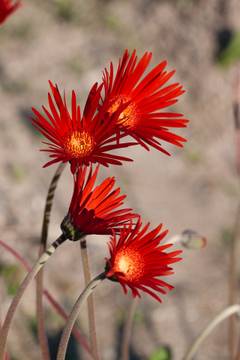
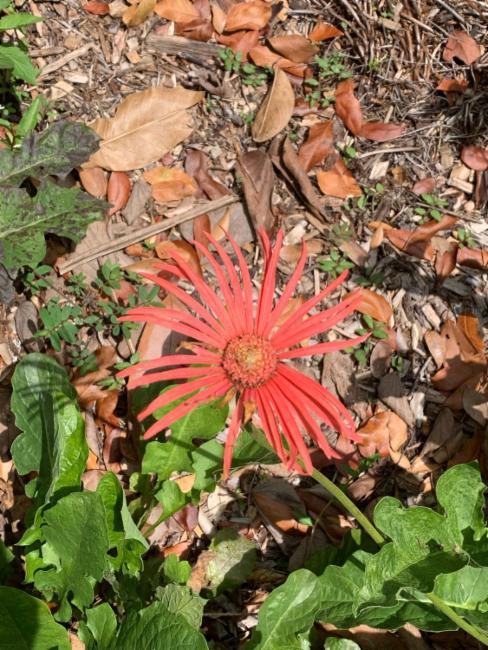
Gerbera is a genus of about 30 species of herbaceous perennials in the daisy family Asteraceae, native to South Africa, Madagascar, tropical Africa, and parts of Asia and South America. Plants form a basal rosette of lobed or pinnately divided leaves 4-14 in (10-35 cm) long, often felted with woolly hairs beneath, from which rise leafless flowering stems 6-18 in (15-45 cm) tall. Each stem carries a single large daisy-like flower head 2-5 in (5-13 cm) across, made up of strap-shaped ray florets surrounding a central disc. The cultivated forms, derived largely from G. jamesonii and its hybrids with G. viridifolia, span red, orange, yellow, pink, cream, and white, in single, semi-double, and double head types. Wild species flower mainly in spring and summer, while greenhouse hybrids bloom over much of the year. The fibrous roots are damaged by both drying out and waterlogging. The genus grows in grassland and on rocky slopes, generally in full sun. Most species are frost-tender and are grown as container or greenhouse plants in cool climates, surviving outdoors only in USDA zones 8 to 11. Crowns set too deep are prone to rot.
Native Range
The genus occurs naturally in South Africa, Madagascar, and tropical Africa, with additional species in South America and across Asia. G. jamesonii, the parent of most cultivated forms, is native to the Transvaal region of South Africa.Suggested Uses
Gerbera is grown as a container and bedding plant, in mixed borders, and under glass for cut flowers, where stems last 7-14 days in the vase. Plants are spaced 12-18 in (30-45 cm) apart. Compact strains suit windowboxes and patio pots.How to Identify
Appearance
Size & Dimensions
Height6" - 1'6"
Width/Spread1' - 1'6"
Bloom Information
Wild species flower chiefly in spring and summer. Under greenhouse conditions modern hybrids flower in repeated flushes through much of the year, each head lasting 4-6 weeks. Spent stems pulled cleanly from the base extend the flowering period.
Detailed Descriptions
Flower Description
red, orange, yellow, pink, cream, or whiteFoliage Description
greenGrowing Conditions
Sun Requirements
Requires 6-8 hours of direct sunlight daily
• Full Sun: 6+ hours of direct sunlight
• Partial Shade: 3-6 hours of direct sunlight
• Full Shade: Less than 3 hours of direct sunlight
Care & Maintenance
Care Guide
Grow Gerbera in full sun to part sun in fertile, humus-rich soil with sharp drainage and a slightly acidic pH of 5.5-6.5. Set the crown slightly above soil level, since crowns buried too deep rot readily. Water consistently to keep the soil evenly moist but never saturated, letting the surface dry between waterings. Feed monthly through the growing season with a balanced fertiliser to sustain continuous flowering. In zones colder than 8, plants are grown in containers and overwintered frost-free at 45-50 F (7-10 C). Crown rot, powdery mildew, and aphids appear in humid or crowded conditions.Pruning
Gerbera needs no structural pruning. Faded flower stems are pulled cleanly from the crown rather than cut, since stubs left behind can rot. Dead outer leaves are removed in spring.Pruning Schedule
Prune: June–August
summer
Container Growing
Suitable for container growing
Minimum container size: 2 gallons