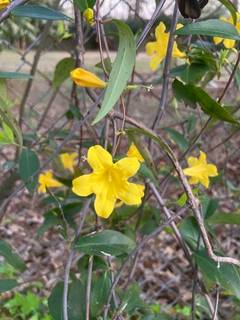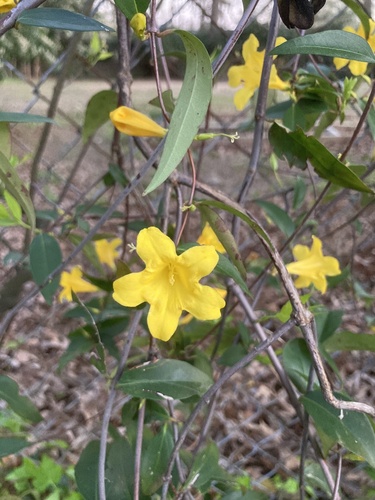
Gelsemium, Genus, spp., Multiple species,
- Genus
- Multiple species
jessamine
Southeastern United States, Mexico, Central America, and Southeast Asia
Overview
Gelsemium is a small genus of three species of evergreen twining vines in the family Gelsemiaceae, two native to the southeastern United States and Central America and one to Southeast Asia. Plants climb by twining woody stems to 10-20 feet (3-6 m), clothed in glossy, lance-shaped leaves 1-3 inches (2.5-8 cm) long that may take on a purplish cast in winter cold. The flowers are tubular and flared into five lobes, 1-1.5 inches (2.5-4 cm) long, in bright yellow, and in G. sempervirens they are strongly fragrant. G. sempervirens flowers in late winter and spring, G. rankinii flowers in both spring and autumn but without scent, and the Asian G. elegans is grown little outside its range. All parts of every species contain gelsemine and related alkaloids and are highly toxic if eaten; the nectar can poison honeybees. The vines grow along fences, trees, and roadsides in their native woodlands. Without support the stems form a sprawling groundcover mound. G. sempervirens is the state flower of South Carolina.
Native Range
Gelsemium is native to the southeastern United States and adjacent Mexico and Central America, with one species, G. elegans, in Southeast Asia. The American species grow in woodland edges, thickets, and along streams and fences across the coastal plain and piedmont.Suggested Uses
Grown on fences, arbors, trellises, and mailboxes for early-season yellow flowers, and allowed to trail over walls and banks as a groundcover. It is used in southeastern native and pollinator gardens, though its toxicity is a consideration where children or livestock are present. The evergreen foliage gives year-round screening on supports.How to Identify
Appearance
Size & Dimensions
Height10' - 20'
Width/Spread3' - 6'
Bloom Information
G. sempervirens flowers in late winter and early spring, generally February to April, with fragrant yellow trumpets. G. rankinii flowers in both spring and autumn but without fragrance. Flowering is heaviest on stems exposed to full sun, and sparse in deep shade.
Detailed Descriptions
Foliage Description
glossy green, purplish in winterGrowing Conditions
Sun Requirements
Requires 4-10 hours of direct sunlight daily
• Full Sun: 6+ hours of direct sunlight
• Partial Shade: 3-6 hours of direct sunlight
• Full Shade: Less than 3 hours of direct sunlight
Care & Maintenance
Care Guide
The American species grow in full sun to part shade in moist, well-drained, acidic soils rich in organic matter, and flower most freely in sun. Established plants tolerate drought, heat, and brief cold to about 10F (-12C), with hardiness covering roughly USDA zones 7 to 9. A support such as a trellis, arbor, or fence is needed for the twining stems, which become heavy and woody with age. All parts are toxic if eaten, and contact with sap causes skin irritation in some people. Few pests trouble the vines, and deer tend to leave them alone because of their toxicity.Pruning
Pruning after the spring flush controls size and removes the buildup of old woody stems at the top of the plant. Hard renewal pruning every few years prevents a bare, heavy tangle. Cut stems and sap contain toxic alkaloids that can irritate skin.Container Growing
Suitable for container growing
Minimum container size: 5 gallons