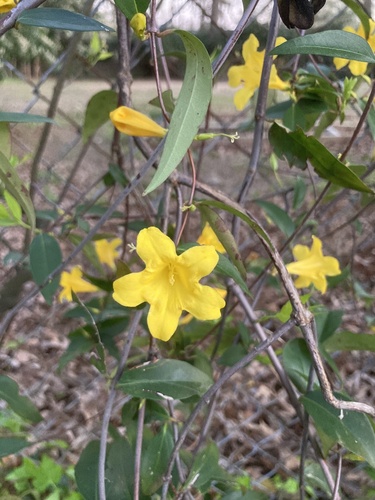
Gelsemium, Genus, sempervirens, Species,
- Genus & species
Carolina jessamine
Southeastern United States, Mexico, Central America
Overview
Gelsemium sempervirens is Carolina jessamine, a twining evergreen vine climbing 120–240 inches (300–600 cm). Yellow funnel-shaped flowers 1–1.5 inches (2.5–4 cm) long in late winter to early spring (February–April), with a moderate sweet fragrance. Dark green glossy lance-shaped leaves 2–4 inches (5–10 cm) arranged in opposite pairs along wiry twining stems. The species name 'sempervirens' means 'always green.' State flower of South Carolina. Native to the southeastern United States, Mexico, and Central America. All parts are highly toxic — the plant contains gelsemine and other indole alkaloids that affect the central nervous system. Ingestion of any part (including nectar) causes respiratory failure. Honey produced from the flowers is also toxic. Children have been fatally poisoned by sucking nectar from the flowers. Deer-resistant due to the toxicity. Twining habit — requires a support structure (trellis, fence, arbor) or can be allowed to scramble as a groundcover on slopes. Full sun to partial shade — more flowers in full sun. Drought-tolerant once established. Adapts to clay, loam, and sandy soils. Zones 7–10. Growth rate is moderate to fast — 24–48 inches (60–120 cm) per year. Prune after flowering in spring. No serious pest or disease problems.
Native Range
Native to the southeastern United States from Virginia to Florida to Texas, and south through Mexico into Central America. Found in woodlands, roadsides, and forest margins.Suggested Uses
Grown on trellises, fences, arbors, and mailbox posts in zones 7–10, or as a scrambling groundcover on slopes. Full sun for maximum flowering. All parts highly toxic — position away from areas where children or livestock may contact the plant or its nectar.How to Identify
Appearance
Size & Dimensions
Height10' - 20'
Width/Spread3' - 6'
Bloom Information
Detailed Descriptions
Flower Description
Yellow, funnel-shapedFoliage Description
Dark green, glossyGrowing Conditions
Sun Requirements
Requires 4-8 hours of direct sunlight daily
• Full Sun: 6+ hours of direct sunlight
• Partial Shade: 3-6 hours of direct sunlight
• Full Shade: Less than 3 hours of direct sunlight
Care & Maintenance
Care Guide
Full sun to partial shade — more flowers in full sun. Drought-tolerant once established. Adapts to clay, loam, and sandy soils. Prune after spring flowering. All parts highly toxic (gelsemine alkaloids) — including nectar and honey. No serious pest or disease issues. Deer-resistant. Zones 7–10.Pruning
Prune for shape and size control immediately after flowering in spring. Blooms on old wood — pruning at other times removes flower buds. Can be cut back hard for rejuvenation if overgrown.Pruning Schedule
Prune: April–May
spring