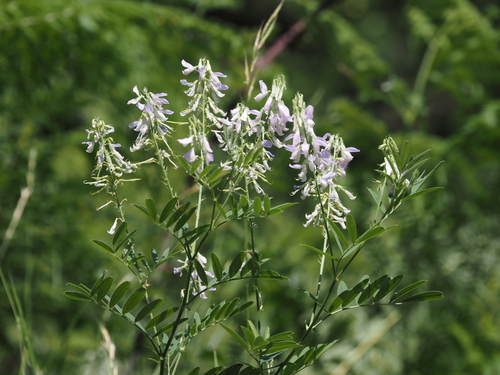
Galega, Genus, officinalis, Species,
- Genus & species
common milkpea
Southern and central Europe, the Caucasus, and western Asia
Overview
Galega officinalis is an upright herbaceous perennial legume reaching 2-5 feet (60-150 cm) tall and 2-3 feet (60-90 cm) wide, forming a clump of hollow, branching stems from a woody crown. Leaves are pinnately compound, 4-8 inches (10-20 cm) long, with 11-17 lance-shaped to oblong leaflets, each tipped with a short bristle. Pea-like flowers 0.4-0.5 inch (10-12 mm) long are carried in dense erect racemes 1.5-3 inches (4-8 cm) long from June to September, ranging from pale lilac and blue-mauve to white. Flowers give way to narrow cylindrical pods 1-1.5 inches (2.5-4 cm) long holding several seeds. The plant dies back to the crown each autumn and regrows in spring. Roots fix atmospheric nitrogen through rhizobial nodules. All parts contain the alkaloid galegine, which is toxic to grazing mammals and has caused livestock deaths. Galega officinalis is a Federal Noxious Weed in the United States and spreads readily by seed in moist ground.
Native Range
Native to southern and central Europe, the Caucasus, and western Asia east to Iran and Pakistan. It grows in damp meadows, ditches, riverbanks, and other moist disturbed ground at low to middle elevations.Suggested Uses
Grown in damp wildflower meadows, informal borders, and as a nitrogen-fixing green manure or forage crop, spaced 18-24 inches (45-60 cm) apart. Its prolific self-seeding and Federal Noxious Weed status restrict use in the United States and parts of Australia and New Zealand. White-flowered selections are grown in cottage gardens within Europe.How to Identify
Appearance
Size & Dimensions
Height2' - 5'
Width/Spread2' - 3'
Bloom Information
Blooms from June to September in most temperate regions, with peak flowering in July and August. Individual racemes last about 2-3 weeks and a clump produces successive spikes over 6-10 weeks. Flowering is reduced in dry soils and heavy shade.
Detailed Descriptions
Flower Description
pale lilac to whiteFoliage Description
greenGrowing Conditions
Sun Requirements
Requires 4-8 hours of direct sunlight daily
• Full Sun: 6+ hours of direct sunlight
• Partial Shade: 3-6 hours of direct sunlight
• Full Shade: Less than 3 hours of direct sunlight
Care & Maintenance
Care Guide
Grows in full sun to part shade on moist, fertile soils and tolerates seasonal waterlogging. Watering supports establishment in the first season; established plants flower poorly in dry ground. As a nitrogen-fixing legume it needs no supplemental feeding. Self-seeding is prolific, with one plant producing hundreds of viable seeds that persist in soil for years, and seedlings appear around the parent unless seedheads are removed before they ripen. Cutting stems back after flowering limits spread. Few pests or diseases affect it, and its galegine content makes it hazardous where livestock graze.Pruning
Cut flowering stems to the base after bloom to prevent seed set and curb self-sowing. Whole clumps are cut to ground level in late autumn once the foliage yellows. Cutting before pods ripen is the main check on spread.Pruning Schedule
Prune: October–November
summerfall