Galega, Genus, spp., Multiple species,
- Genus
- Multiple species
goat's rue
Europe, western Asia, and northeastern Africa
Overview
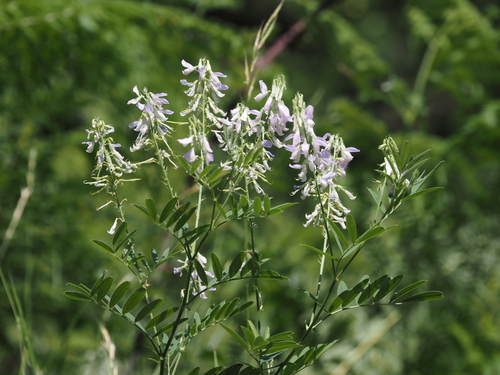
Galega is a genus of upright herbaceous perennials in the pea family, Fabaceae, with roughly six to eight species native to Europe, western Asia, and northeastern Africa. Plants form clumps of erect, branching stems 2-5 feet (0.6-1.5 m) tall clothed in pinnately compound leaves divided into 9-17 oblong leaflets. From early to midsummer the stems carry dense upright racemes of small pea-type flowers in shades of lilac-blue, mauve, pink, and white, each spike holding 30 to 50 blooms. Flat cylindrical seed pods follow. As legumes, the plants fix atmospheric nitrogen through root nodules and were once grown as forage and green manure. The genus contains the alkaloid galegine, which is toxic to grazing livestock, and G. officinalis is listed as a federal noxious weed in the United States because it spreads aggressively in pastures and wet ground. G. orientalis from the Caucasus spreads by rhizomes and forms persistent colonies. Plants die back to the rootstock each winter and resprout in spring. The coarse, bushy habit and rapid spread limit the genus to larger, informal plantings.
Native Range
Galega is native to Europe, western Asia, and northeastern Africa, growing in damp meadows, streambanks, and disturbed ground. G. officinalis has naturalized widely outside its range and is regulated as a noxious weed in parts of North America.Suggested Uses
Grown in informal borders, cottage gardens, wildflower meadows, and damp areas where its spread is acceptable. The long-stemmed flower spikes are cut for arrangements. Historically the genus was sown as fodder and green manure for its nitrogen-fixing roots.How to Identify
Appearance
Size & Dimensions
Height2' - 5'
Width/Spread2' - 3'
Bloom Information
Flowering runs from early to midsummer, generally June through August. Each upright raceme opens its pea-type flowers over 2-3 weeks, and a clump produces a succession of spikes. Removing spent spikes before pods ripen reduces self-seeding, which can be heavy.
Detailed Descriptions
Flower Description
lilac-blue, mauve, pink, whiteFoliage Description
blue-greenGrowing Conditions
Sun Requirements
Requires 5-10 hours of direct sunlight daily
• Full Sun: 6+ hours of direct sunlight
• Partial Shade: 3-6 hours of direct sunlight
• Full Shade: Less than 3 hours of direct sunlight