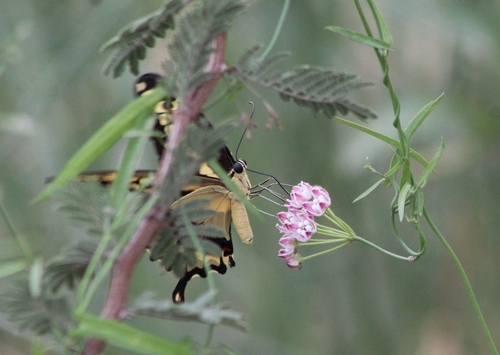
Funastrum, Genus, heterophyllum, Species,
- Genus & species
Hartweg's climbing milkweed
Southwestern United States and northern Mexico
Overview
Funastrum heterophyllum is a slender twining perennial vine of the desert Southwest, climbing 3-10 feet (0.9-3 m) over shrubs and fences by wrapping its stems around supports. The narrow leaves vary in shape from linear to lance-shaped, 1-2.5 inches (2.5-6 cm) long, and the stems exude a milky white sap when broken. From spring through autumn it bears rounded clusters of small star-shaped flowers, each about 0.3 inch (8 mm) across, in cream to pale yellow with a central crown typical of the milkweed group. Pollinated flowers develop into slender pods 2-4 inches (5-10 cm) long that split to release flat seeds carried on silky white hairs. F. heterophyllum grows along desert washes, canyon edges, and among shrubs in sandy or gravelly soil, climbing toward light through its supports. All parts contain milky latex with toxic cardiac glycosides, and the sap can irritate skin and eyes. Its twining stems can smother small host plants, and the vine dies back in cold winters, returning from the rootstock.
Native Range
Funastrum heterophyllum is native to the southwestern United States and northern Mexico, including Arizona, New Mexico, southern California, and Texas. It grows along desert washes, canyon margins, and among shrubs in sandy and gravelly soils.Suggested Uses
F. heterophyllum is used in desert and native gardens, pollinator and butterfly plantings, and on trellises and fences in warm, dry regions, where it serves as a monarch and queen butterfly host. Its long bloom feeds a range of desert insects. The toxic sap and smothering twining stems make it suited to informal native plantings rather than small mixed beds.How to Identify
Appearance
Size & Dimensions
Height3' - 10'
Width/Spread3' - 6'
Bloom Information
F. heterophyllum flowers over a long warm season from spring into autumn, roughly April through October, with bloom heaviest after rains. The cream to pale yellow flower clusters draw bees, wasps, and butterflies, and the plant serves as a larval host for monarch and queen butterflies. Slender seed pods follow and split open to release wind-borne seeds.
Detailed Descriptions
Flower Description
Cream to pale yellowFoliage Description
GreenGrowing Conditions
Sun Requirements
Requires 6-12 hours of direct sunlight daily
• Full Sun: 6+ hours of direct sunlight
• Partial Shade: 3-6 hours of direct sunlight
• Full Shade: Less than 3 hours of direct sunlight