Funaria, Genus, hygrometrica, Species,
- Genus & species
bonfire moss
SunFull Sun – Part Shade
WaterMedium
Overview
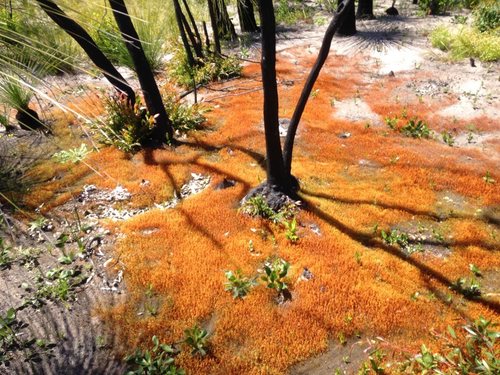
Funaria hygrometrica is a small, short-lived moss that colonises bare, nutrient-rich ground, especially old bonfire sites and burnt soil, which gives it the common name bonfire moss. It forms loose green to yellowish-green tufts, the leafy shoots only 0.2-1.2 inches (5-30 mm) tall, with broad, concave leaves gathered into a bud-like rosette at each stem tip. The moss is readily identified by its abundant spore capsules: each is pear-shaped, curved, and asymmetric, ripening from green to orange-brown, and nods on a long yellow to red stalk 0.4-2 inches (1-5 cm) long. These stalks are strongly hygroscopic, twisting and untwisting as humidity changes, which helps scatter the spores. It appears quickly on disturbed, fertilised, or recently burned soil and on the ash of old fires, in gardens, fields, paths, and waste places worldwide. Each colony is usually brief, fruiting heavily and then dying back as longer-lived plants move in. As a non-vascular plant it has no roots and absorbs water across its surface, anchoring with rhizoids. It is widely used as a model organism in plant research.
Native Range
Found on every continent, including Antarctica, and across most climates. Its range has expanded with human activity, since it colonises the disturbed, burned, and fertilised ground that people create.Suggested Uses
Grown mainly in teaching and research as a model moss, and sometimes in terraria and on disturbed soil in moss gardens. It suits bare, fertile, sunny ground that other mosses colonise slowly. It is short-lived and not suited to permanent ground cover.How to Identify
Appearance
Colors
Foliage Colors
Fall Foliage Colors
Bloom Information
As a moss it does not flower. It fruits heavily, with curved, asymmetric spore capsules ripening from green to orange-brown through spring and summer on long, twisting stalks. Spores are shed in large numbers as the stalks coil and the capsule mouth opens.
Detailed Descriptions
Foliage Description
yellowish green to greenGrowing Conditions
Sun Requirements
Requires 4-10 hours of direct sunlight daily
• Full Sun: 6+ hours of direct sunlight
• Partial Shade: 3-6 hours of direct sunlight
• Full Shade: Less than 3 hours of direct sunlight
Water & Climate
Water Needs