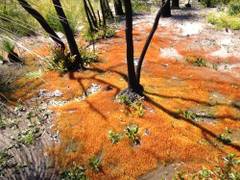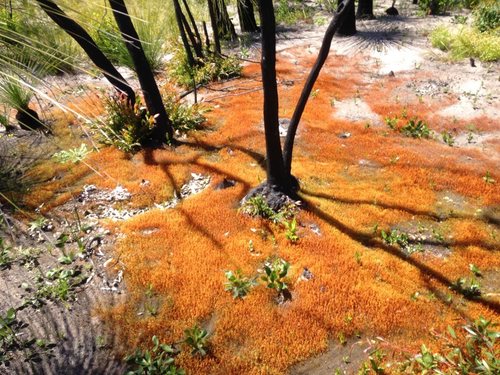
Funaria, Genus, spp., Multiple species,
- Genus
- Multiple species
cord moss
SunFull Sun – Part Shade
WaterHigh
Overview
Funaria is a genus of small mosses in the family Funariaceae, found almost worldwide and most familiar through F. hygrometrica, the common cord moss or bonfire moss, which quickly colonizes burnt ground, bare soil, and disturbed sites. As a moss, Funaria is non-vascular: it has no true roots, flowers, or seeds, anchoring instead by thread-like rhizoids and reproducing by spores. Plants form low green to yellow-green tufts only 0.2-1.2 inches (5-30 mm) tall, with small, soft, oval leaves crowded toward the stem tips. After fertilization, each shoot produces a slender stalk (seta) that is strongly twisted and changes shape with humidity, bending and straightening as it dries and wets. At its tip sits an asymmetric, pear-shaped, ribbed spore capsule that nods to one side, ripening from green to orange-brown. Funaria grows on damp, often nutrient-enriched soil, ash beds, greenhouse pots, paths, and walls, appearing fast after fire or disturbance and fading as larger plants move in. It needs moisture to grow and complete its spore cycle and dries to a dormant state in drought.
Native Range
Funaria has a cosmopolitan distribution, occurring on every continent including parts of Antarctica. F. hygrometrica occurs on all continents and is found on disturbed and burnt ground around the world.Suggested Uses
Funaria is little used in horticulture and is encountered mainly as a spontaneous colonizer rather than a planted moss. It acts as an early stabilizer of bare and burnt soil and is used as a study subject in botany and in research on moss biology. Its quick appearance can mark recently disturbed or fire-affected ground.How to Identify
Appearance
Size & Dimensions
Width/Spread1" - 4"
Colors
Foliage Colors
Fall Foliage Colors
Bloom Information
Funaria does not flower. Spore capsules develop on the twisted setae mainly in spring and early summer in temperate regions, though in mild and watered sites they can appear at other times. The capsules ripen from green to orange-brown over several weeks and release spores as they dry and the lid falls away.
Detailed Descriptions
Foliage Description
green to yellow-greenGrowing Conditions
Sun Requirements
Requires 2-8 hours of direct sunlight daily
• Full Sun: 6+ hours of direct sunlight
• Partial Shade: 3-6 hours of direct sunlight
• Full Shade: Less than 3 hours of direct sunlight
Water & Climate
Water Needs