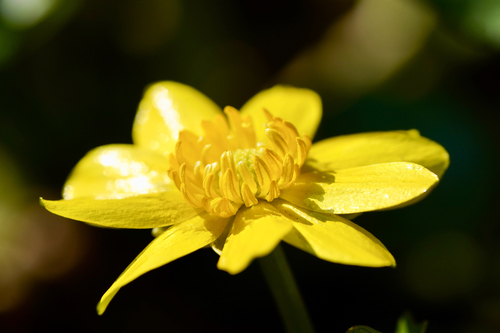
Ficaria, Genus, verna, Species,
- Genus & species
lesser celandine
Europe, western Asia, and northwest Africa
Overview
Ficaria verna is a low-growing spring ephemeral perennial in the buttercup family, reaching 2-6 inches (5-15 cm) tall and forming spreading colonies. It emerges in late winter from clusters of small finger-shaped tubers, producing glossy, dark green, heart- to kidney-shaped leaves 0.4-1.6 inches (1-4 cm) across on long stalks. From late winter into spring it bears solitary, star-shaped flowers 0.8-1.2 inches (2-3 cm) wide with eight to twelve glossy yellow petals that fade toward white with age. The plant reproduces by seed, by the tuberous roots, and by tiny bulbils that form in the leaf axils of some subspecies; these bulbils detach and wash downstream, allowing rapid colonization of floodplains and moist woodland. By early summer the foliage yellows and the plant dies back completely, leaving bare ground until the following winter. It grows in damp, partly shaded soils along streams, in floodplain forests, and in lawns, where it can form a continuous mat that excludes spring wildflowers. In North America it is listed as invasive across much of the Northeast and Pacific Northwest. All parts contain protoanemonin and are toxic if eaten raw, causing mouth and digestive irritation.
Native Range
Ficaria verna is native to Europe, western Asia, and northwest Africa. It has naturalized in North America, where it spreads along streambanks and in moist woodlands and is regulated as invasive in states including Connecticut, Massachusetts, Oregon, and Washington.Suggested Uses
Ficaria verna is occasionally grown in shaded, moist gardens and woodland plantings for its early flowers, and double-flowered and bronze-leaved cultivars are sold for this use. Because it spreads aggressively and is regulated in many areas, its garden use is limited to contained sites where it cannot reach waterways. The early bloom and summer dormancy suit it to ground beneath deciduous shrubs where later plants fill the gap.How to Identify
Appearance
Size & Dimensions
Height2" - 6"
Width/Spread6" - 1'
Bloom Information
Flowering occurs from late winter through mid-spring, generally February to April. The solitary yellow flowers open in sunshine and close in dull weather or at night, each lasting several days as the petals fade from glossy yellow toward near white. Bloom finishes as the foliage begins to die back in late spring.
Detailed Descriptions
Foliage Description
dark greenGrowing Conditions
Sun Requirements
Requires 3-6 hours of direct sunlight daily
• Full Sun: 6+ hours of direct sunlight
• Partial Shade: 3-6 hours of direct sunlight
• Full Shade: Less than 3 hours of direct sunlight
Care & Maintenance
Care Guide
Ficaria verna grows in full sun to partial shade in moist to wet soils high in organic matter, and is most active on damp floodplains and streambanks. It needs no supplemental water during its late-winter to spring growth, drawing on stored reserves in its tubers, and requires no fertilizing. Once the foliage dies back in early summer the plant is dormant and the ground appears bare until the next season. The species spreads readily by tubers and bulbils, so soil disturbance and water movement carry it into new areas. Dense stands form quickly in suitable habitat and crowd out low spring vegetation. Removing it requires lifting every tuber and bulbil, as fragments left in the soil regrow.Pruning
No pruning is needed for this ephemeral, which dies back on its own by early summer. Where control is wanted, plants can be dug before flowering finishes and seed or bulbils form, with all tubers taken from the soil. Cutting the foliage alone does not stop spread, since the tubers persist underground.Pruning Schedule
Prune: March–April
early spring
Container Growing
Suitable for container growing
Minimum container size: 1 gallons